
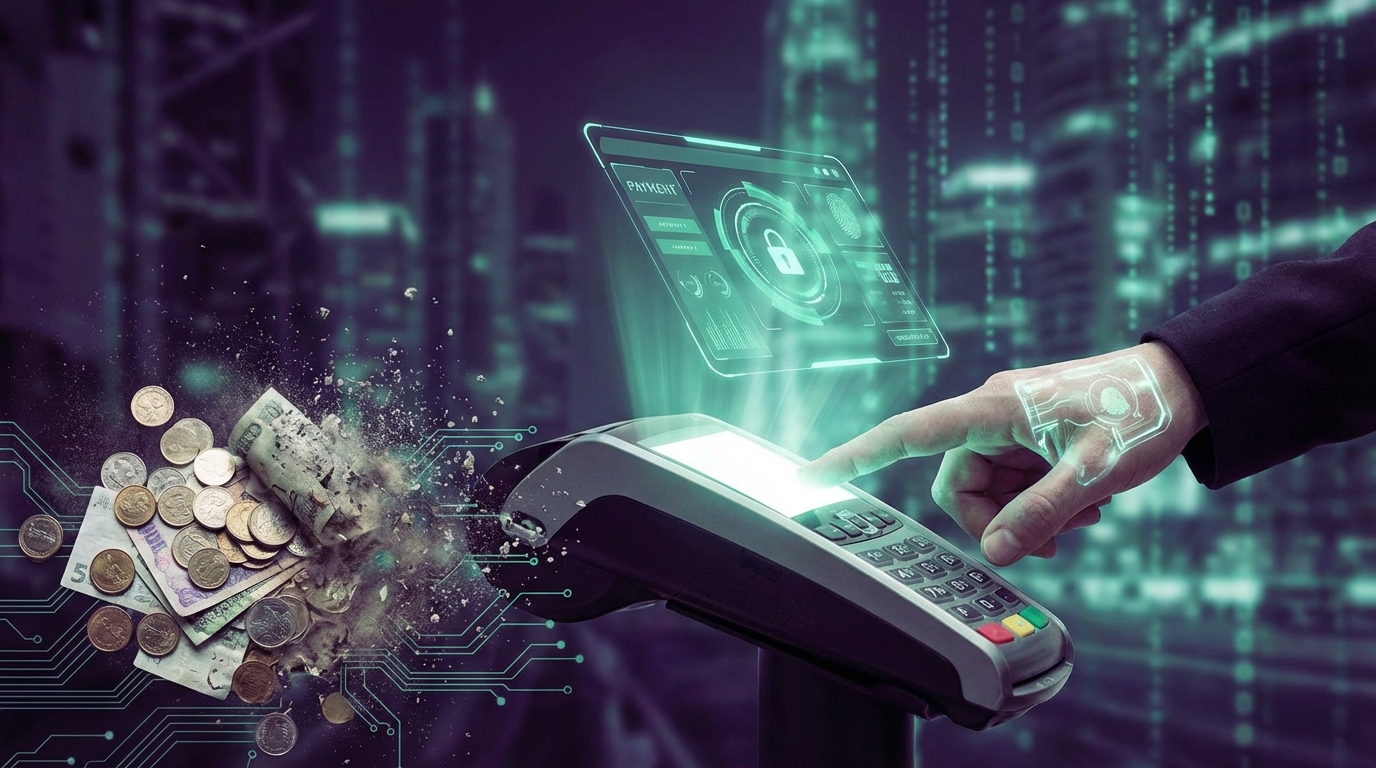
“The first country that makes cash irrelevant will not be the one with the best app. It will be the one that makes trust, fees, and fraud feel invisible.”
The market is already voting: card networks, wallets, and real-time rails now process more value every day than physical cash in most major economies. Cash is not dead yet, but its profit share is shrinking fast. For founders, the future of payments is less about killing coins and notes and more about owning the interfaces, data, and credit rails that replace them.
The numbers tell a simple story. In Sweden, cash is under 10 percent of point-of-sale transactions. In China, super apps like WeChat Pay and Alipay reach hundreds of millions of users with QR-based payments that make banknotes look slow and rigid. In the US, debit and credit still dominate, but contactless, BNPL, and peer-to-peer rails like Zelle and Cash App are carving away at cash-heavy verticals. The trend is not clear yet for every region, but investors keep backing products that make cash less relevant in daily spending.
The business value here is not about payments alone. Payments are a wedge. Whoever controls the payment flow gets first look at transaction data, credit risk, and customer intent. That means monetization through lending, interchange, loyalty, subscriptions, and SaaS. Cash offers none of that. It has zero data exhaust, zero digital touch, and zero recurring revenue. So every startup that removes one cash transaction from the system, even if the fee is low, opens a new path for higher-margin products.
The economics of killing cash
For all the talk about crypto and contactless, cash still serves three roles: store of value, medium of exchange, and social fallback when systems fail. From a business perspective, each role has a different revenue profile.
Banks spend money to print, store, move, and insure cash. Retailers spend money to count, reconcile, and deposit it. Governments spend money to secure and monitor it. None of these parties earn direct income from the physical flow itself. The profit sits around it: ATM fees, overdrafts, merchant services, loyalty programs, and lending.
Digital payments flip that model. They add marginal cost in software, fraud tooling, and customer support, but every transaction can carry a fee or trigger a higher-value event.
“Payments are not a product; they are an ingredient. The margin shows up in lending and services, not in the swipe fee itself.”
Investors look for this pattern in every payment startup pitch:
1. Can you displace cash in a specific flow where cards or wallets are under-penetrated?
2. Can you reach enough volume to negotiate better rates or design your own rails?
3. Can you attach lending, subscriptions, insurance, or software around that flow?
The ROI shows up when the cost of acquiring a user for one use case, like peer-to-peer or gig worker payouts, turns into cross-sell across multiple revenue lines. Cash cannot do that. It is anonymous and low-friction for the user, but it is a dead end for revenue beyond basic services like ATM access.
The four forces pushing cash to the edge
1. Regulation and tax collection
Governments do not earn fees from card taps or QR scans, but they get something they value more: traceability. When transactions become digital, tax gaps shrink and compliance goes up. That creates clear financial upside for states.
In India, the 2016 demonetization shock was messy and uneven, but it accelerated digital payment adoption at a pace no marketing budget could match. UPI (Unified Payments Interface) later turned into a national rail that made peer-to-peer transfers and QR codes almost free at the point of use.
“When you make digital payments cheaper than cash logistics, the market tilts itself. You do not need to outlaw cash to make it irrelevant.”
For founders, this means policy risk cuts both ways. A government push can turbocharge adoption of one rail, like UPI or Brazil’s Pix, while compressing margins for private players. At the same time, regulators can cap interchange, tighten KYC, or limit wallet balances, affecting business models that rely on fees or float.
The trend is uneven. Some countries still protect cash access by law, forcing banks to maintain ATM networks and branches. Others nudge cash out of large transactions through reporting rules and limits on cash payments for cars, property, and high-value goods. The commercial opportunity often sits where policy objectives (tax visibility, AML, financial inclusion) align with consumer demand for convenience.
2. Consumer behavior and trust
Cards beat cash on safety and rewards but lose on immediate anonymity and tactile control. Mobile wallets bring convenience and, in some cases, better UX, but bring questions about data, privacy, and vendor lock-in.
User research keeps surfacing the same pattern:
“Consumers do not wake up wanting ‘a new payment rail’. They want fewer steps at checkout, clearer pricing, and less fear of being scammed.”
This is where cash still holds ground:
– Small informal trades like street vendors, tipping, and local services
– Demographics who handle budgets in envelopes or fear overdrafts
– People who mistrust banks, platforms, or surveillance
For startups, ignoring these segments leaves money on the table. The winning products do not just assume cash is bad. They design for:
– Microtransactions without punitive fees
– Clear balance views that mimic the envelope system
– Soft declines or controls that prevent unintentional debt
BNPL products grew by presenting a digital version of layaway and installment culture. They did not “invent” new behavior. They digitized existing mental models and framed them in a familiar way. The next wave of cash displacement will follow the same pattern.
3. Merchant economics
Ask a small shop owner about payment terminals and you get blunt math: card fees eat into narrow margins; cash counting eats into time and risk. Merchants run tradeoffs:
– Cash: no acquiring fee, but time cost, theft risk, and deposit runs
– Cards and wallets: fee per transaction, but faster lines and easier reconciliation
– Account-to-account systems (like UPI or Pix): low or no fee but sometimes weaker dispute resolution or incentives
Over time, when a merchant’s customer base shifts to wallets and cards, refusing digital payments hurts sales more than the fee hurts margin. That is the tipping point where cash starts to fade in that environment.
For founders building merchant tools, the ROI narrative must be explicit:
– Show labor hours saved in reconciliation and cash handling
– Show lower theft or shrinkage
– Show loyalty lift from digital receipts, rewards, or CRM tools built on top of payment data
Payments alone rarely sell. Payments plus clear revenue or cost impact does.
4. Infrastructure and rails
The real story behind cash decline sits in the rails most consumers never think about:
– Instant settlement vs batch
– Card network rules and chargebacks
– National real-time systems
– FX costs for cross-border flows
When instant account-to-account rails become widely available and reliable, the need for physical cash decreases for both P2P and merchant payments. That is why Brazil’s Pix rose so fast: it matched local payment needs with a simple, cheap rail backed by the central bank.
For startups, building directly on these rails can reduce unit costs, but also exposes them to commoditization. A wallet built only on a public instant rail without added value faces both price pressure and low switching friction.
The winning pattern: use the rail as plumbing, then wrap it in UX, credit, reconciliation, or vertical-specific software that creates stickiness.
Is cash obsolete yet? The real answer is: by segment
Cash is not a single monolith. Its role differs by country, industry, and income level. To assess “obsolescence,” you need to slice the market.
High-income, urban, banked populations
For these users, cash is already near-obsolete for:
– Subscriptions and recurring bills
– Online shopping
– Most travel and mobility services
Where cash still appears:
– Tipping service workers
– Small peer-to-peer gifts or sharing
– Certain local services like repairs or informal childcare
From a founder’s view, this segment now expects digital by default. The gap is not “can you pay without cash,” but “how many apps and accounts must you juggle to manage your money.” The ROI lies in aggregation, budgeting, and embedded finance rather than raw payment acceptance.
Low-income, underbanked, or informal workers
Cash remains dominant where:
– People are paid daily or weekly in physical currency
– Trust in banks and large platforms is low
– KYC hurdles exclude users from formal accounts
Here, cash is not obsolete; it is the base layer. To change that, products must address two questions before any growth metrics matter:
1. Can users get paid digitally in the first place?
2. Can they cash out or spend locally without high friction or fees?
Mobile money in parts of Africa answered those questions through agent networks and USSD, not smartphone apps. The business model leaned on fees, float, and later lending. The lesson for new players: UX is not only the app. It is the whole route from wages to spend to savings.
Cross-border and remittances
Remittances remain a large source of cash pickup, even when senders fund transfers digitally. The reason is rooted in local access, regulation, and habit. A worker in the US might send through an app, but the recipient in a rural town may still prefer hard currency.
Here, “cash obsolete” is less relevant than “cash last mile shrinking.” Every time an agent point turns into a wallet, card, or QR-accepting merchant, some part of that last mile turns digital.
For founders, cross-border payments mix regulatory complexity with strong consumer loyalty. The business value grows when you shift the recipient from pickup to digital wallet and then to bill pay, lending, or shopping within your network.
Retro specs: what 2005 thought about the future of cash
To understand how founders should think about the future of payments now, it helps to rewind to 2005 and read what people predicted then.
“In 10 years, your phone will replace your wallet. You will pay for everything with a simple tap or text message.” (Tech magazine, 2005)
In 2005, NFC on phones was barely a prototype for most consumers. SMS billing and premium text services were the closest thing to mobile payments many people saw. Retail terminals lagged, and card networks controlled most digital spend.
User reviews from that era show both curiosity and skepticism:
“I tried paying with my phone at a vending machine. It worked, but it felt like a gimmick. I still carry cash because I do not want to get stuck if the signal drops.” (User review, 2005)
The mental model then saw the phone as a companion to cash, not a replacement. Bank branches and ATMs were the main access points to money. Online banking started to gain traction, but bill pay and transfers often took days.
To visualize how predictions from that period compare to reality, look at a simple “Then vs. Now” view focused on devices and payment norms.
| Feature | 2005 (Then) | 2025 (Now) |
|---|---|---|
| Primary payment at checkout | Magstripe card or cash | Contactless card, mobile wallet, or QR in many regions |
| Mobile phone role | Occasional SMS billing, ring tones, limited WAP commerce | Always-on wallet, banking app, P2P, identity second factor |
| Online commerce | Desktop checkout, manual card entry, limited stored cards | One-click checkout, tokenized cards, account-to-account options |
| Peer-to-peer payments | Cash handover, checks, bank transfers with long delays | Instant app-based P2P with social feeds in some apps |
| Cash share at point of sale (developed markets) | Often above 50 percent for small transactions | In many cities, below 20 percent and trending down |
| Authentication | Signatures on receipts, basic PIN | Biometrics on phones, multi-factor auth, device binding |
| Remittance pickup | Mostly cash pickup at agents | Mix of cash pickup, wallets, cards, and bank credits |
| Merchant hardware | Dedicated dial-up POS units, cash registers | Smartphone or tablet POS, software-based terminals, QR stickers |
Another angle is to compare iconic hardware of that time with modern devices, not for raw specs but for payment capability.
| Device | Era | Payment Capability Then | Payment Capability Now |
|---|---|---|---|
| Nokia 3310 | Early 2000s | No native payments; some regions had operator billing via SMS | Reissue versions can host basic apps, but still not a primary wallet |
| iPhone (1st gen) | 2007 | No NFC; payments through web or early apps with card entry | Modern iPhones support NFC wallets, in-app pay, biometric auth |
| Feature phone (generic, 2005) | 2005 | USSD and SMS could support mobile money pilots | In some regions, still central to mobile money ecosystems |
| Modern smartphone (2025) | 2025 | Full wallet, P2P, POS acceptance in some cases, identity | Standard platform for both paying and getting paid |
User commentary from 2005 also captured fears that sound familiar today, just aimed at different rails:
“If everything goes through one big company, what happens when their system goes down? At least with cash, I can still buy food.” (Forum post, 2005)
Those concerns remain, but the target has shifted from mobile carriers and early online wallets to big tech, card networks, and super apps. The common thread: concentration of power brings both convenience and risk.
Where founders can still win in a post-cash trajectory
The central question for startups is not “Will cash die,” but “Which parts of the payment stack are still open for new entrants as cash fades.”
Vertical-specific payment flows
General-purpose wallets and cards cover broad spending, but several verticals still have clunky flows with high cash usage:
– B2B trade in small and mid-sized businesses
– Field services and home repairs
– Micro mobility and local transport in some cities
– Informal rentals and shared living expenses
These flows often mix invoicing, partial payments, deposits, and recurring charges. Generic POS tools handle the swipe or tap but do not handle the business logic around it.
Founders who blend vertical software with embedded payments can convert cash or checks into digital flows while capturing higher-margin SaaS revenue. The payment becomes an entry point to job management, inventory, scheduling, or income smoothing.
Credit built on real-time data
Cash hides credit risk and income patterns. Digital payments expose both. That creates room for small working capital products, earned wage access, and micro credit tied directly to payment flow.
The ROI for lenders improves when:
– They see real-time transaction data
– They can collect repayments at source from future flows
– They can price risk more precisely than traditional underwriters
As cash share shrinks, the data available for such models grows. The open question is who will control that data. Banks, card networks, wallets, and merchant providers all want that position.
Startups that sit closer to the merchant or worker, rather than just the consumer card, have an edge. They can see both sides of the transaction and design products aligned with cash flow timing, not generic monthly cycles.
Offline resilience and hybrid models
Cash still wins when:
– Networks fail
– Power outages hit
– Systems are under cyber attack
Any claim that cash is obsolete must address these scenarios. For critical sectors like food retail, fuel, and health, full dependency on online rails introduces systemic risk.
This is an opening for products that combine digital convenience with offline fallback:
– Stored value on secure elements that can sync when back online
– Local offline credential checks that later reconcile
– Hybrid POS that can accept both tokens and cash with unified reporting
Urban users might see fewer banknotes, but the system itself will need options that span both digital and physical to manage risk.
Crypto, stablecoins, and the cash comparison
Crypto advocates often describe tokens as “digital cash.” That analogy holds in some narrow senses: peer-to-peer, bearer-like, and sometimes pseudonymous. From a business and regulatory perspective, though, they behave differently.
Founders exploring stablecoins as payment tools face a different tradeoff:
– On-chain transfers can be cheap and programmable
– Fiat on- and off-ramps still often require licensed intermediaries
– Volatility (for non-stable assets) weakens the store-of-value role for day-to-day spending
For now, crypto adoption for retail payments remains small compared to fiat wallets. Stablecoins gain more traction in:
– Cross-border treasury operations
– B2B settlement in specific corridors
– Trading and DeFi use cases
If a stablecoin layer ever reaches mass retail, it will still need UX, regulation, and merchant acceptance layers similar to current rails. The business value may lie more in reduced FX and faster settlement than in replacing cash at the coffee shop.
How incumbents position for a low-cash world
Banks, card networks, and big tech firms are not passive in this shift. Their moves shape the space where startups can operate.
Banks
Banks want to keep deposits and loans while reducing physical branch and ATM costs. Digital payments help them do that, but they risk disintermediation by wallets and fintechs.
Their strategies include:
– White-label rails like instant payments connected to fintech front-ends
– Co-branded cards and wallets
– Aggressive mobile banking upgrades, integrating P2P, bill pay, and budgeting
For founders, banks can be both partner and competitor. The partnership path can provide access to licenses and balance sheets but can slow product cycles. Direct competition means going after user relationships with UX and brand while relying on banks for back-end functions.
Card networks
Card networks earn from transaction volume and acceptance. Cash decline benefits them when transactions shift to cards, but less so when national instant rails take share.
Their responses:
– Tokenization and network tokens for secure digital commerce
– Push into account-to-account and real-time products
– Partnerships with wallets, super apps, and fintechs
They will keep pushing pricing power and value-added services, like fraud tools and data products. Startups that depend solely on card rails must model fee pressure and incentive dynamics carefully.
Big tech and super apps
Platforms with large user bases and daily engagement treat payments as a glue that increases stickiness.
– Messaging apps that add P2P and merchant payments
– Ride-hailing and delivery apps that issue wallets and cards
– Marketplaces that extend into credit and savings
These players compete with both banks and startups for the same margin pools: interchange, lending, and merchant services. Their strength lies in distribution. Their weakness can be regulatory scrutiny and user concerns about data concentration.
For founders, the choice is either to build inside these platforms as integrations or to own niche segments that large players overlook or cannot serve well because of compliance or brand constraints.
Then vs. now: how “cashless” expectations shifted
In 2005, a “cashless” future often meant card everywhere and fewer ATMs. By 2025, the concept is richer: embedded finance, one-click checkouts, invisible billing, and subscriptions that charge without user action.
A final “Then vs. Now” view helps capture the shift in expectations.
| Aspect | 2005 Expectation | 2025 Reality |
|---|---|---|
| Who owns the wallet? | Banks and card issuers | Mix of banks, big tech wallets, telecoms, fintechs, and super apps |
| Main fear | Online fraud and card theft | Data misuse, platform lock-in, account takeover |
| Offline fallback | Always cash | Cash still present, but some locales lean on offline card and stored value |
| Role of government | Print money, regulate banks | Operate instant rails, push ID systems, set data and privacy rules |
| Startup path | Provide payment gateway or POS hardware | Embed payments into vertical SaaS, marketplaces, or super apps |
| Cash perception | Default payment medium | Backup option, still central for specific segments and regions |
The history lesson suggests a few grounded takeaways.
Predictions that cash would vanish by a specific year were wrong. Human habits, regulatory constraints, and infrastructure gaps slowed that path. Yet in many urban and digital-first contexts, cash already plays a secondary role.
For founders and investors, the key is to segment the world, not average it. Cash is nearing obsolescence for certain users, flows, and regions, and it remains primary for others. The opportunity lies in building the rails and products that serve each segment on its own terms, while the overall system continues its uneven shift from paper to packets.