“By 2030, every serious enterprise will run on two clouds: one for speed, one for sovereignty.”
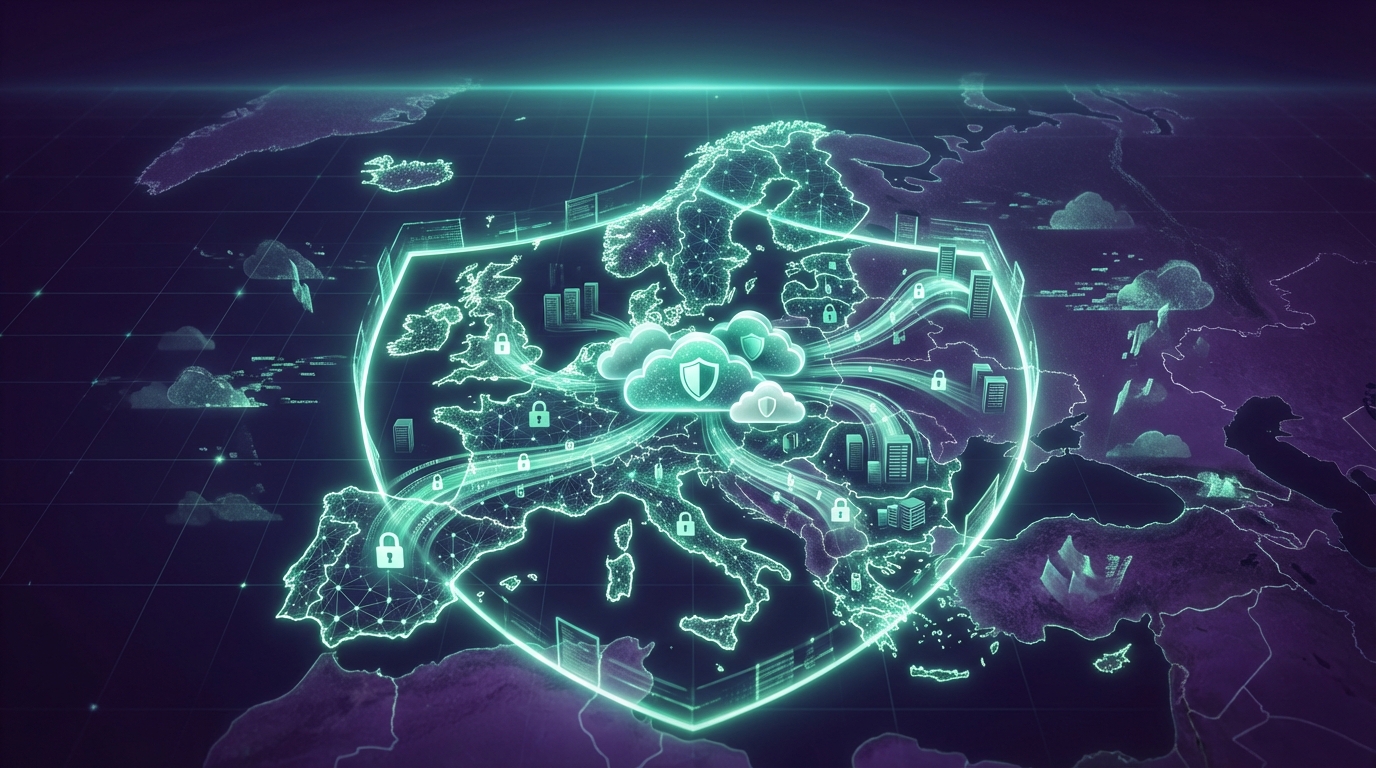
The market is quietly splitting into two classes of cloud: global and sovereign. The first one optimizes for scale and cost. The second one optimizes for control, locality, and regulatory trust. For EU businesses, that split is no longer just a technical preference. It is starting to decide who wins government contracts, who lands regulated customers, and who avoids eight‑figure fines under GDPR. The core question investors keep asking founders now is simple: “Where does your data live, who can touch it, and under which legal system?”
The phrase “sovereign cloud” used to sound like a press release term. Now it filters real money. The European Commission keeps tightening enforcement around data residency and cross‑border transfers. Large enterprises in banking, health, energy, and public sector treat data locality as a procurement checkbox, not a nice‑to‑have. US hyperscalers race to partner with EU telcos and national champions. Local cloud providers position themselves as the “no US law risk” alternative. None of this is about abstract privacy ideals. It is about business value: who can sign the largest long‑term contracts without legal uncertainty sitting on the balance sheet.
The trend is not linear. The law is evolving, courts keep rewriting the boundary conditions, and regulators send mixed signals. Investors look for signs that a startup has a realistic read on this mess. A founder that shrugs and says “we use AWS and GDPR is fine” now triggers concern. A founder that explains which data stays in a sovereign EU environment, which data is pseudonymized before transfer, and how Standard Contractual Clauses are backed by technical controls gets a very different reception. The ROI is simple: lower compliance risk, faster enterprise sales, and higher contract values because legal teams do not stall for months.
The history here matters. A lot of the current “sovereign cloud” push is a delayed reaction to decisions made 15 to 20 years ago.
Retro Spec 2005: “Nobody cares where the server is, as long as the site loads.”
Typical view in hosting forums when US data centers undercut European providers on price.
In the mid‑2000s, the mainstream web ran on US soil. European startups deployed to affordable racks in Virginia or California without thinking much about public law. Data protection rules existed, but enforcement was weak and cross‑border flows sat under broad political agreements. The assumption: the internet is global, and jurisdictional details are something telecom lawyers handle in the background.
Fast‑forward to now, and that assumption is broken. Privacy has become a political project in Europe. The US and EU have clashed in court multiple times over surveillance and data export rules. National cybersecurity agencies put out formal warnings about foreign control over critical infrastructure. CIOs who grew up in the era of “just host it on the cheapest cloud” now spend board meetings explaining which regulator can subpoena which data.
This is the environment in which “sovereign clouds” are rising.
What a “sovereign cloud” actually means in practice
Vendors market the term aggressively, so the definition stretches. From an investor perspective, it helps to break it down into four concrete properties:
1. Data residency: where the bits live at rest
The basic layer: all primary and backup data sits physically in data centers located inside the EU, often inside a specific member state. That includes:
– Application data
– Logs and telemetry
– Backups and archives
– Support snapshots
This seems simple. It rarely is. Many cloud services spray logs across regions, replicate indexes globally, or send error traces to US‑hosted observability tools. A “sovereign” claim fails if even a small subset leaks across borders.
2. Legal jurisdiction: which court and which law apply
The second layer goes beyond geography. Investors and compliance teams care about which legal system has authority over:
– The infrastructure operator
– The company that controls the encryption keys
– The support staff that can access systems
This is where the US CLOUD Act enters every serious conversation. The concern is not academic. If a US parent company or US‑controlled entity runs the service, European regulators worry that US law enforcement could request data, even if the servers sit in Frankfurt or Paris.
Expert Opinion (2020): “Location is not enough. Sovereignty is about who controls the provider, not just where the racks stand.”
EU data protection officer speaking at a cloud compliance workshop.
Modern sovereign cloud projects address this with either EU‑only entities, joint ventures with EU majority control, or strict data trustee models where an EU partner holds keys and operational control.
3. Operational control: who can log in, debug, and patch
The third layer focuses on people and processes. Sovereign projects often enforce:
– EU‑only or EEA‑only support personnel for sensitive workloads
– Screening and contractual controls for admin access
– Local change management processes audited by national agencies
If a security incident hits, the local operator must handle it without routing logs or dumps to a global support center. That has direct impact on incident response time, which feeds back into ROI calculations for customers in regulated sectors.
4. Technical controls: encryption, key management, and segregation
Finally, sovereign setups rely heavily on:
– Encryption at rest and in transit as a baseline
– Customer‑managed keys or keys under EU‑controlled hardware security modules
– Strong tenant isolation between regions and workloads
These controls serve a dual purpose: risk reduction and legal signaling. If data is encrypted with keys held only by an EU entity, foreign legal requests become less meaningful, and regulators gain confidence that exposure risk is limited.
Then vs now: how cloud thinking changed
To understand the rise of sovereign cloud, compare the mid‑2000s mindset with the current one. The contrast shows why so many European policymakers push for local control.
| Aspect | 2005 “Classic Hosting” | 2025 “Sovereign Cloud” Mindset |
|---|---|---|
| Primary driver | Lowest monthly cost and uptime | Regulatory safety, long‑term risk, ROI over years |
| View of jurisdiction | Rarely discussed in sales calls | Front‑page topic in RFPs and board packs |
| Typical provider | US data center with global clients | EU operator, often with public sector ties |
| Security posture | Basic firewalls and shared hosting | Encryption everywhere, strict access control |
| Regulation impact | Low enforcement, vague threats | Real fines, binding rulings, political pressure |
| Customer questions | “Is it fast?” | “Can a non‑EU authority access our data?” |
User Review from 2005: “My host is in the US but it’s like 5 dollars a month and never goes down. Why pay more for a local one?”
That comment from a 2005 web hosting forum captures the old economics. Price per month and basic reliability won. Local hosts often looked expensive and less polished, so many European businesses shifted abroad. At that stage, data was not yet the central asset it is today. Analytics pipelines were primitive. Machine learning did not drive product decisions at scale. Data loss or exposure hurt reputations, but company value still tied more to physical assets and offline channels.
Today, for a SaaS or data‑heavy startup, the database is the business. Breach risk connects straight to enterprise value. A damaging regulatory decision can block entire markets. In this environment, the math changes. Paying extra for sovereign control becomes rational when the upside is access to public sector deals, health projects, or financial contracts that global clouds cannot easily win under strict procurement rules.
Why EU regulators push data to stay inside the EU
From the EU policy side, three drivers keep coming up: legal conflict with foreign surveillance laws, strategic autonomy, and trust as a competitive advantage.
1. Legal conflict: Schrems, privacy shields, and CLOUD Acts
The last decade brought a sequence of legal shocks that made cross‑Atlantic data flows fragile. Courts challenged the compatibility of US surveillance rules with European fundamental rights. Each time a broad agreement was struck, a new ruling questioned its sufficiency.
For business leaders, the legal theory matters less than the operational effect: recurring uncertainty. Contracts that once felt safe now need regular review. Corporate lawyers now treat US‑EU data transfers as a “watch weekly” item, not a solved topic.
Sovereign clouds offer an escape hatch. If sensitive processing never leaves EU jurisdiction, and if control stays with an EU operator, the exposure to foreign surveillance law reduces. That does not magically solve every risk, but it narrows the field. For a bank’s risk committee or a health ministry, that narrowing is valuable.
2. Strategic autonomy: avoiding single‑country dependence
EU industrial policy has long worried about dependence on non‑EU suppliers for key technologies. Energy, telecom gear, and chips all triggered political debates. Public cloud joined that list once people realized how much critical infrastructure now runs on three US‑based platforms.
Sovereign cloud projects tie into a broader strategy: keep a credible European option alive for workloads that touch defense, public records, citizen IDs, health systems, and financial market infrastructure. The pitch is not that EU providers will replace hyperscalers across the board. The pitch is that Europe should not be fully dependent on a legal and political system it does not control.
Data Point (2022): “Around 92% of the Western world’s data is currently stored in the US.”
Figure often cited in European policy debates on cloud and data sovereignty.
Investors see this as a signal. Where political will and procurement align, markets appear. National governments start setting objectives like “x percent of public sector workloads on EU‑controlled clouds by year y”. That flows into billions of euros worth of contracts over a decade.
3. Trust as a commercial asset
For EU businesses selling to privacy‑aware customers, data locality has become a marketing line. The logic goes like this:
– Privacy laws in the EU set high standards.
– Hosting and processing entirely inside the EU signals compliance ambition.
– That signal justifies premium pricing or helps close large deals.
A SaaS vendor that says “all your EU customer data stays in EU data centers under EU law” removes an objection. Data residency stops being a legal footnote and becomes a sales feature. Over time, that can turn into a differentiator against global competitors that cannot match the same level of locality without rearchitecting their platforms.
Business value: how sovereign cloud changes ROI math
The shift to sovereign setups adds cost and complexity. The reason the trend still gains momentum is that the return outweighs the extra spend for certain segments.
1. Faster enterprise sales cycles
Legal and security reviews are now central bottlenecks in B2B SaaS sales. A product champion may love your tool, but if the Data Protection Officer or Chief Information Security Officer flags cross‑border risks, the deal stalls for months or dies.
Running on a sovereign EU cloud reduces that friction. Procurement teams tick more boxes faster:
– Data location is clear.
– Jurisdiction exposure is limited.
– Certifications match local norms.
Investors see this in pipeline metrics. Companies that design for sovereignty early often show shorter security review phases and higher conversion on big‑ticket opportunities.
2. Access to regulated and public sector markets
Many high‑value markets either prefer or mandate local control:
– Health data platforms
– Financial services and trading infrastructure
– Public administration systems
– Critical infrastructure monitoring (energy, transport, water)
For these buyers, “EU‑only” operation can be a hard requirement. If your product physically cannot meet it, your addressable market shrinks. For venture‑backed startups, that constraint matters. It sets a ceiling on contract size and sector reach.
Founders that pick sovereign‑ready architectures early keep those doors open. That shows up years later in revenue composition. Rather than only selling to marketing teams and small businesses, they can bid for multi‑year state contracts and large financial institutions.
3. Lower regulatory risk exposure
Every decision about data location interacts with GDPR and sector‑specific rules. If a company pushes large volumes of sensitive data to non‑EU regions without strong controls, the downside is clear: complaints, audits, and potential fines.
Hosting the most sensitive workloads on a sovereign cloud reduces the probability and potential impact of such events. Insurance premiums may reflect that. Internal audit reports certainly do. For investors, this feeds into risk discount rates. Fewer legal uncertainties mean cleaner forecasts and valuations.
4. Stronger customer lifetime value
Customers that trust you with regulated data are less likely to churn. Migrating core systems under strict data controls is painful. The switching cost locks in revenue.
Sovereign positioning often leads to long contracts:
– Five‑year government framework deals
– Multi‑year bank or insurer arrangements
– Multi‑tenant health platforms with integration into hospital systems
That stability has direct financial impact. It smooths revenue, supports lending capacity, and underpins higher enterprise value multiples.
How big players are responding: global vs sovereign offerings
US hyperscalers see the same pressures. They are not walking away from Europe. Instead, they add layers to their offerings to speak to sovereignty concerns.
US hyperscalers: partnerships and “EU regions plus” models
The standard pattern looks like this:
– Dedicated EU regions for data residency
– Customer‑managed encryption keys with EU‑based key storage
– Special support regimes for sensitive workloads
– Partnerships with EU telecom operators or IT integrators, sometimes with joint ventures branded as national clouds
From a technical perspective, much of the stack still comes from the global provider. The nuance lies in legal structuring and operational separation.
For some regulators and enterprises, this is enough. They gain the benefit of global cloud features with improved locality. For more cautious sectors, these offerings still raise questions: can a US authority reach into the parent company and compel access?
Local and regional providers: pure EU control as a pitch
European cloud companies and national champions take the opposite stance: full EU ownership, local staff, and often strong ties to public authorities.
Their pitch focuses less on cutting‑edge AI platforms and more on:
– Compliance with national security and certification schemes
– Predictable legal exposure
– Integration with local telco and government networks
Between 2005 and now, many of these providers evolved from basic hosting to full IaaS and PaaS offerings.
| Feature | 2005 EU Host | 2025 EU Sovereign Cloud |
|---|---|---|
| Service scope | Shared hosting, simple VPS | Full IaaS/PaaS, managed Kubernetes, databases |
| Target client | Small websites, forums, blogs | Banks, hospitals, ministries, large SaaS vendors |
| Compliance focus | Basic uptime SLAs | GDPR, local security schemes, sector standards |
| Support model | Email ticketing, limited hours | 24/7, on‑site if needed, EU staff only for sensitive workloads |
| Pricing strategy | Compete on low monthly fees | Compete on risk reduction and regulatory fit |
From a startup’s perspective, this creates a trade‑off. Global clouds often lead on platform features and ecosystem. Sovereign EU clouds lead on regulatory fit. Many young companies now adopt hybrid models that try to get the best of both.
Architectural choices: building products that respect EU data boundaries
Technical architecture decides how much freedom you have on data location. The earlier you make sovereignty part of design, the cheaper it is to support later.
1. Data classification: not all data needs the same protection
An effective approach starts with clear classes:
– Class A: highly sensitive personal or regulated data
– Class B: business data that clients want within the EU
– Class C: low‑sensitivity operational data and metadata
You keep Class A strictly inside sovereign EU environments, often isolated per client. Class B may sit in EU regions of global clouds. Class C can live where performance or cost justify it, with proper consent and documentation.
Investors like to see this discipline in product architecture reviews. A founder that treats all data the same usually points to rework later.
2. Separating data plane and control plane
Many SaaS products follow a pattern where:
– The data plane (where customer records live) is regionalized, e.g., EU‑only for EU clients.
– The control plane (authentication, configuration, metrics) may be global, but stripped of personal data.
This design helps answer hard questions in RFPs. You can say, with precision, which parts never leave the EU. Over time, you can even migrate control plane pieces regionally if needed.
3. Encryption and key management choices
Sovereign setups lean heavily on strong cryptography with clear key ownership stories:
– Customer‑managed keys where high‑value clients hold control
– Hardware security modules in EU facilities
– Minimal key exposure to non‑EU staff or systems
These choices add operational overhead but buy trust. They also reduce the practical impact of any legal order that compels access outside the EU.
4. Logging, analytics, and “shadow exports”
One of the most common failure modes in sovereignty claims sits in the supporting tools:
– Centralized logging systems in non‑EU regions
– US‑hosted analytics tools that ingest user identifiers
– Third‑party monitoring that receives live traces
From a compliance angle, these count as data exports. A serious sovereign posture requires:
– EU‑hosted versions of these tools
– Or strict anonymization and aggregation before export
Founders that ignore this end up in awkward conversations when large prospects run detailed vendor assessments.
Pricing models: sovereign vs global cloud for startups
Cost is still a factor. Sovereign options often charge more, but the gap is not as large as many assume, especially at scale.
| Cost / Value Aspect | Global Cloud Only | Hybrid with Sovereign EU Cloud |
|---|---|---|
| Raw compute & storage price | Lower per unit | Moderate premium per unit |
| Compliance & legal spend | Higher over time for regulated deals | Lower, fewer custom clauses and reviews |
| Sales cycle length (enterprise) | Longer with more objections | Shorter where sovereignty is a checkbox |
| Addressable market | Limited access to some public/regulated sectors | Full access if architecture supports strict residency |
| Platform features & managed services | Very broad | Depends on vendor, sometimes narrower |
| Long‑term risk exposure | Higher dependence on cross‑border legal regimes | More control within EU law |
Investors run scenarios here. If sovereign capability unlocks one extra multi‑million‑euro contract each year, the extra infrastructure spend often pays for itself immediately.
Open questions: where the trend is still blurry
The rise of sovereign cloud in Europe feels strong, but the path is not perfectly straight.
1. How strict will enforcement stay?
Regulators send a mix of strong messages and pragmatic allowances. Some national authorities push rigid positions on cross‑border data transfers. Others show more flexibility for companies with robust safeguards.
This inconsistency means founders and investors must track local guidance, not just EU‑wide rules. The business implication: product and go‑to‑market strategies may need country‑level nuance.
2. Can European providers keep up on feature depth?
Global clouds invest enormous sums into AI platforms, managed services, and global edge networks. European sovereign providers rarely match that investment size.
For many B2B applications, the gap is acceptable. For AI‑heavy or highly specialized workloads, developers still gravitate to hyperscalers. That tension shapes hybrid architectures, where some components live on sovereign platforms and others stay on global ones.
3. How will customers weigh performance vs sovereignty?
Latency and availability still matter. A purely national cloud may have fewer regions and fewer data centers per country. For consumer apps, that may be a bigger factor than legal exposure.
For high‑value B2B and public sector workloads, sovereignty tends to win. For consumer entertainment or casual services, cost and speed may still dominate. The market lines will sharpen over the next few years as procurement patterns stabilize.
What this means for EU founders and operators
Founders building in Europe do not need to turn into lawyers, but they cannot ignore this theme. Investors, especially growth and late‑stage funds, now ask targeted questions about data residency. The answers influence not only legal risk assessments but also revenue projections.
For many products, the winning formula looks like this:
– Architect with clear data separation and regionalization from day one.
– Keep the most sensitive EU customer data on sovereign or strongly EU‑bound setups.
– Use global clouds where they offer clear technical or cost advantages, but with strict controls.
– Make sovereignty part of the sales narrative for enterprise and public sector prospects.
The story of hosting from 2005 to 2025 shows how quickly assumptions age.
User Review from 2005: “GDPR? Never heard of it. My host gives me unlimited bandwidth and cPanel, that’s all I need.”
Back then, the legal layer barely entered product conversations. Now, data locality and legal control sit next to performance and price when buyers choose a provider. Sovereign clouds are not a marketing fad in that context. They are one of the main levers Europe is pulling to keep its data, and the value built on top of that data, inside its own borders.