
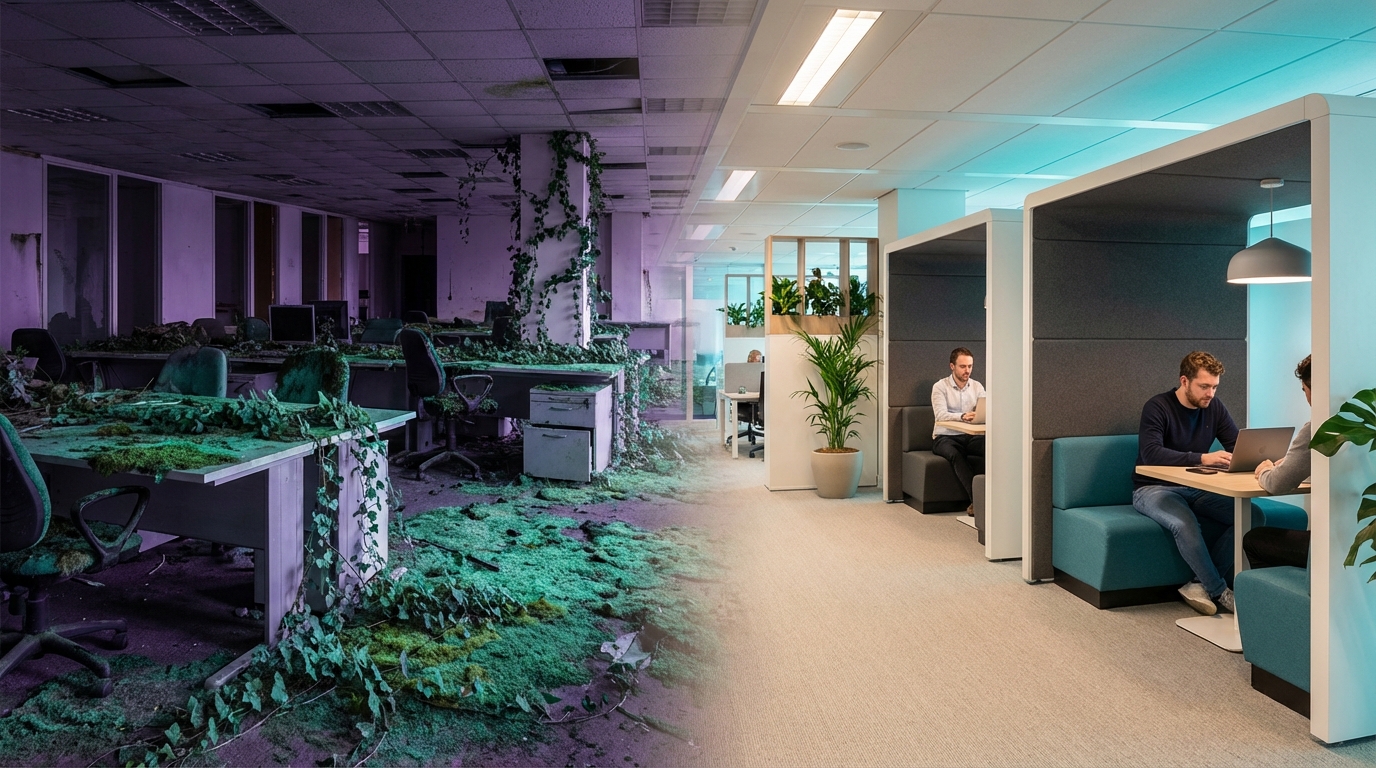
“Open plan offices did not fail because people hate collaboration. They failed because the math on focus, health, and retention stopped working.”
The market is quietly killing the open plan office. Not with a press release, but with budget lines, sublease listings, and employee churn data. Companies that once bragged about long bench desks and “no walls” are now paying for soundproof pods, hybrid schedules, and smaller, higher-yield offices. The story here is not design taste. It is ROI. Real estate costs sit on one side of the ledger. Output, retention, and health sit on the other. The numbers started favoring focus over floorplate density, and investors are tracking that shift.
The trend is not fully clear yet, but signals line up: fewer square feet per employee no longer looks smart when attrition rises and high performers complain about noise more than meetings. Founders used to view office density as proof of growth. Today, growth startups are more likely to brag about “two days in, three days remote” than “open plan culture.” It feels like a cultural shift, but it is driven by unit economics. The open plan bet was simple: pack more people in, cut walls, spark more collaboration, and save rent. The problem is that collaboration did not rise enough to offset the cost of distraction, and rent savings got eaten by people leaving or zoning out.
Investors look for repeatable models. The open plan office turned out to be a productivity lottery. Some teams thrived, many did not, and leadership lacked levers to fix it without rewriting the space. Headphones became the default workaround. That is not a system, it is a bandage.
The next phase of workspaces will not be about fantasy campuses. It will be about precise control: when people come in, what they do there, how the space supports that, and how those choices affect burn rate and output. The new office is less about where you sit and more about what the company expects that square foot to produce.
The rise and fall of the open plan business case
Open plan was not a design accident. It was a financial product sold with a cultural wrapper.
Real estate brokers pushed density metrics. Architects sold collaboration. HR sold culture. Founders saw a chance to put 30 people where 15 used to fit. On paper, cost per head dropped. At seed and Series A, that made sense. Every extra dollar needed to go into product and growth, not drywall.
The promise went like this:
– Tear down walls.
– Save on rent.
– Encourage random collisions.
– Collisions lead to ideas.
– Ideas lead to growth.
The pitch sounded clean. It came with a nice side story about breaking hierarchies and “flat” companies. But the cash return of a floor plan is not theoretical. It lives in things like:
– Time to ship features.
– Sales cycle length.
– Bug rates.
– Sick days.
– Retention curves.
The open plan office started to fail when companies had enough data to connect these dots.
What the noise really costs
Noise is not a vibe issue. It is an arithmetic issue.
Cognitive research points to sharp drops in performance when people face constant background chatter. The market started to see that in numbers. Managers noticed that top engineers and product leads blocked off their calendars just to escape their own office. People came in late or left early because the only way to get “deep work” done was outside the office.
The classic open plan reply was: “We encourage collaboration.” But collaboration without focus becomes chaos. Slack and Zoom covered the collaboration story. They made it much easier to sync without bumping chairs. The office had less leverage on spontaneous ideas than open plan advocates expected.
At the same time, salary costs climbed. A mid-level engineer or AE in a major tech hub can cost 150,000-250,000 dollars per year once you count benefits. When a 70,000 dollar-per-year lease saves 10 percent on space but cuts 20 percent from that engineer’s effective output, the math flips. Rent looks cheap. Lost focus looks expensive.
HR metrics turned into red flags
HR teams began to see a pattern. Feedback surveys and exit interviews started to carry the same theme: noise, lack of privacy, constant interruptions. That did not sink open plan alone, but it did speed the fall.
Remote work pressure accelerated the shift. Teams learned that some of their best work happened away from the long table. Employees started to ask harder questions: “If I can write better code at home and talk to the team on video, why am I commuting to sit in a room where I wear noise-cancelling headphones all day?”
Founders track churn like a leak in a bucket. When exit interviews cite the office itself as one of the reasons people leave, the space stops being a neutral cost and starts being a risk factor.
What comes after the open plan office
The next office model will not be a simple swing back to private offices or cubicles. That would be too blunt, and many companies cannot justify that footprint anyway. The shift looks more like a portfolio strategy across three levers:
1. Hybrid schedules.
2. Zoned offices.
3. On-demand spaces.
Instead of one default (everyone in, every day, all in one room), high-growth teams are testing combinations that match the type of work, the stage of the company, and the talent market they want to hire from.
Hybrid as a CFO tool, not an HR perk
Hybrid work is often framed as an employee benefit, but the more interesting story is financial.
When a company sets clear in-office days, it can reduce the total number of seats. You no longer need a desk for every badge. Instead, you size for the peak usage you target. That shrinks rent and often allows better quality space in a better building.
The trade is simple: fewer days in exchange for better conditions during those days. Founder logic sounds like this: “If I am paying for fewer desks, I can afford more focus rooms, better ventilation, better chairs, and stronger acoustic design.”
Investors like hybrid when it lines up with three things:
– Lower long-term lease liability.
– Stable or rising productivity metrics.
– No major hit to culture or onboarding.
The companies that make it work treat hybrid like an operating model, not a polite suggestion. They define:
– Which teams need to be in together and when.
– What work should happen in-office versus remote.
– How performance is measured in both settings.
That clarity reduces the “two offices” problem where remote people feel like second-class citizens. It also lets real estate planning move from guesswork to something closer to demand forecasting.
Zoned offices: from one space to many micro-spaces
The next version of the office looks less like a single big open room and more like a set of zones. Not chaos, but distinct environments for different work modes.
These zones show up again and again in high-performing spaces:
– Focus zones: Quiet rooms, phone booths, small pods that support heads-down work for one or two people.
– Collaboration zones: Project rooms, whiteboard areas, open tables with large displays for group work.
– Social zones: Kitchens, lounges, cafe-style seating for informal conversation and breaks.
– Transition zones: Hallways and nooks that soak up small chats so they do not spill into focus areas.
The point is not decor. The point is control. A sales team that needs energy can sit near social zones in the afternoon. A research or engineering team can cluster near focus rooms. Managers can hold 1:1s in small rooms instead of whispering at a shared desk.
Architects used to sell open plan as a cultural choice. The new pitch is a productivity layout. Can you give each major type of work a home inside your floorplate, without wasting space on rooms that sit empty?
On-demand and distributed: the fractional office
Many startups now treat office space like cloud compute. They reserve the heavy lift for specific use cases and keep the base load lean.
That can look like:
– A small HQ or studio that anchors leadership and occasional team meetings.
– On-demand access to coworking spaces in multiple cities for distributed hires.
– Short-term project spaces for large sprints, client workshops, or launches.
This “fractional office” model fits companies that hire across regions and do not want to tie themselves to one large lease. It also spreads risk. If one city becomes too expensive or loses talent, the company can rebalance without a massive write-down on a single headquarters.
For investors, this model removes a chunk of fixed cost and shifts it to variable spend tied to activity. You pay for more space in the months you actually run more in-person work. That lines up well with the lumpy nature of product cycles and sales seasons.
Why founders still cling to open plan
If the economics are shifting, why do many companies still hold onto open plan layouts?
There are three main reasons: inertia, symbolism, and flawed measurement.
Inertia and sunk costs
Open plan is baked into many leases, build-outs, and office furniture purchases. Ripping out long bench desks and reconfiguring a floor is not cheap. CFOs see that as a one-time hit that might not clearly show up in revenue next quarter.
If a company signed a 7-year lease with a design built around maximum seat count, change becomes harder. Landlords and tenants negotiate fit-out costs, and those deals can lock both parties into an open layout.
Still, sublease markets and renegotiations are giving companies new openings. Many are now choosing smaller spaces with better internal zoning rather than trying to fix huge open boxes.
Symbolism and visibility
For some leaders, the open plan office symbolizes accessibility. “My desk is next to everyone else” sounds like humility. The problem is that symbolic value does not always translate into performance.
There is also the visual effect. A packed open office looks “busy.” It can give a false sense of productivity. Investors who walk through see people in seats and assume work is humming. Meanwhile, half those people might be trying to escape the noise on Slack.
Good leaders are starting to swap that visual cue for actual metrics: feature velocity, sales pipeline movement, NPS, error rates. They accept that a quiet, half-empty office on certain days might still be doing more valuable work than a packed room full of context switching.
Flawed productivity measurement
The hardest challenge here is attribution. How do you connect the shape of your office to the outcome of your quarter?
Many companies do not measure enough signals to make that link. They rely on lagging indicators like overall revenue and general sentiment surveys. That is too fuzzy.
The more advanced teams are looking at:
– Time to resolve complex tickets by environment (in-office vs remote days).
– Focus block compliance: how many 2-3 hour no-meeting blocks people actually keep.
– Meeting types per day: are in-office days overloaded with status meetings that could be async?
– Voluntary office usage: when people have flexibility, which spaces do they book and when?
Once that data is visible, patterns emerge. Offices that support long focus blocks, easy access to small rooms, and reliable A/V for remote teammates tend to show higher output per head than open rooms full of long tables.
Expert opinions and signals from the market
The shift away from open plan is not just a design blog trend. It shows up in board conversations, audits, and real estate data.
“The most productive engineering teams we see today combine two or three office days with strong norms on when deep work happens. Unstructured open plan five days a week almost never tops that performance.”
That quote reflects what many growth investors now report privately. Their best portfolio companies are not the ones with the coolest-looking offices. They are the ones that treat workspace like a variable in an experiment and align it with the type of work that creates value.
“When we reconfigured 40 percent of our open space into small focus rooms and pods, voluntary office attendance rose and time-to-ship for key features dropped by 18 percent over two quarters.”
This type of internal case study is pushing leaders to reconsider the default layout. It also reframes the cost: not as “spend on decor” but as “investment in throughput.”
“We stopped buying desks for every new hire. We now assume a 0.6 to 0.7 seat ratio. The savings funded build-outs for project rooms and an annual offsite. That trade has a clear retention and productivity bump.”
The market responds when leaders show credible links between real estate strategy and financial performance. The pattern across these quotes is clear: fewer generic seats, more intentional spaces.
Then vs now: what the office was built to do
To understand what comes next, it helps to look at how the purpose of the office itself has changed.
For a long time, offices were containers for tools: phones, filing cabinets, servers, copiers. Work had to happen there because the infrastructure lived there. Open plan rode the backend wave of laptops, cloud, and mobile. Once tools moved to the cloud, the office became more about meetings and culture than equipment.
Now we are in a third phase. The office is a product that must earn its usage. It has to beat the alternative: a decent home setup, a local coworking space, or a quiet library. That force creates pressure for better design and sharper function.
Here is a simple table to compare the old open plan logic with the emerging model:
| Office Model | Primary Goal | Key Metric | Main Risk |
|---|---|---|---|
| Classic Open Plan | Maximize seat count and visual energy | Cost per seat per month | Noise, distraction, burnout |
| Hybrid Zoned Office | Match space to work modes and schedules | Output per employee per in-office day | Coordination overhead, uneven usage |
| Distributed + On-demand | Flex cost base and widen talent pool | Retention, hiring speed, travel cost | Cohesion, onboarding depth |
The open plan office tried to be all three at once and ended up excelling at none. It provided cheap seats, but not strong support for deep work or flexible talent strategies.
How this affects startup strategy and funding
For startups, office decisions hit multiple parts of the business model: burn, hiring, and culture.
Burn rate and runway
Real estate is usually one of the top three non-people expenses. In early stages, shaving 10-20 percent off that line can extend runway by months. But compressing everyone into a loud room is not free. The hidden cost is slower product progress and higher staff churn, which burn cash through rehiring and delayed growth.
Investors are growing more sensitive to this trade. Many now ask:
– How large is your committed lease relative to headcount and growth plans?
– What is your seat ratio (people per desk)?
– How flexible is your office footprint over the next 24-36 months?
Founders who clarify their workspace strategy with clear metrics send a signal that they think in systems, not vanity. That can help in fundraising conversations, especially with funds that see many portfolio companies stuck in painful sublease situations.
Talent competition
The best candidates now weigh workspace configuration just like they weigh compensation and equity. They have seen enough bad open plan setups to know that layout is not a trivial detail.
Questions candidates ask:
– How loud is your office?
– How many focus rooms do you have per 10 employees?
– What is your policy on remote and hybrid work?
– Do you expect people to be on-site for focus work or mostly for collaboration?
Founders who answer with precision gain an edge. “We are in three days, but two of those are heavy on collaboration, and Fridays are mostly remote focus” sounds far stronger than “We like being together.”
In a tight talent market, a thoughtful workspace strategy becomes a lever for attracting people who care about their craft and their time.
Culture and onboarding
The office is still the fastest way to transmit culture. New hires pick up rituals, sense power dynamics, and learn informal rules by observing small interactions. Open plan once felt like a way to expose people to as much of that as possible.
The problem: open plan amplifies noise, not signal. New hires hear many conversations that do not concern them and miss the context that does. Zoned offices, regular in-person rituals, and well-designed hybrid norms can spread culture more cleanly.
Onboarding programs that combine:
– Structured remote learning.
– Planned in-office weeks.
– Small group sessions in quiet spaces.
often beat the “sit next to us and absorb” model that open plan encouraged.
Design patterns for the “post-open-plan” office
If open plan is fading, what are companies actually building instead? Certain patterns show up in many of the newer spaces.
Fewer permanent seats, more shared resources
Desks are no longer the default anchor. Many offices now feature:
– Shared bench areas for people who come in 2-3 days per week.
– Storage lockers for personal items instead of assigned drawers.
– Larger investment in shared rooms and areas that serve multiple teams.
This shift changes how people relate to the office. They visit it for specific work types and interactions rather than as a static “home” for their laptop. That can feel less personal at first, but the trade is more access to high-quality rooms and tools.
Acoustic design as a first-class feature
Sound used to be an afterthought. Today, serious offices plan for:
– Absorptive materials in ceilings and walls.
– Carpets and soft surfaces in busy areas.
– Clear distance between social and focus zones.
– Phone booths that actually isolate noise.
Companies that ignore acoustics end up paying for expensive furniture that lives in a sonic swamp. Those that treat sound as part of productivity infrastructure often see immediate gains in concentration and fewer complaints about “Zoom echo.”
Always-on remote support baked into rooms
Hybrid broke the old “everyone in the conference room” assumption. Now, almost every meeting has at least one remote participant. That changes room design:
– Cameras at eye level, not stuck in a corner.
– Good microphones that catch everyone at the table without a tangle of wires.
– Screens placed so remote faces are visible without neck strain.
– Easy ways to share screens for both in-room and remote people.
The new office treats remote colleagues as full participants, not afterthought voices from a laptop. That reduces the “two-tier” risk where in-office people make decisions informally and remote people feel excluded.
Then vs now: open plan mythology against hybrid reality
To make the shift concrete, compare how teams once sold open plan internally with how they now talk about hybrid and zoned spaces.
| Aspect | Open Plan Story (Then) | Hybrid / Zoned Story (Now) |
|---|---|---|
| Collaboration | “Everyone in the same room sparks ideas.” | “We plan collaboration-heavy days with the right rooms and tools.” |
| Focus | “Wear headphones when you need quiet.” | “We protect dedicated focus blocks and support them with quiet spaces.” |
| Cost | “More people per square foot reduces rent per head.” | “We balance footprint with performance data and flexibility.” |
| Culture | “Seeing everyone all the time builds culture.” | “Consistent rituals, clear norms, and selected in-person moments build culture.” |
| Control | “The office is the default place for all work.” | “The office is one of several tools for specific work and connection.” |
The shift is subtle but powerful. Companies move from a one-size-fits-all space to a selective toolkit.
Measuring ROI in the new office model
Investors care about numbers. The next generation of offices will stand or fall on the ability to show that space decisions create or destroy value.
Some useful metrics:
1. Output per in-office day
Track core output by location and schedule. For example:
– Lines of high-quality code merged per developer per in-office day.
– Qualified opportunities created per AE per in-office day.
– Design deliverables completed per designer per in-office day.
Compare that with remote days. Over time, you will see which activities benefit from physical proximity and which do not. Then you can tailor office schedules and space to amplify those gains.
2. Retention and engagement tied to workspace changes
When you change your office layout or hybrid model, track:
– Voluntary turnover in the following 12-18 months.
– Internal engagement scores with space-related questions.
– Time to fill key roles.
If a new layout cuts seat count but raises retention among top performers, that is a strong signal that the change created value.
3. Space utilization and booking patterns
Meeting room and desk booking systems hold rich data:
– Which rooms are most booked and at what times?
– Which days see peak attendance?
– Are focus rooms constantly full while open seating sits half empty?
Those signals help you reconfigure over time. If phone booths are used all day, you likely still have an unmet need for quiet spaces.
4. Health and sick day patterns
Poorly designed open plan offices can increase the spread of illness. Crowded seating, shared air, and lack of barriers raise exposure. Track:
– Sick days per quarter.
– Clusters of illness after high-density events.
– Ventilation and air quality metrics where possible.
Health data is harder to pin directly to layout, but when combined with utilization and scheduling, it helps shape safer, more resilient spaces.
What early-stage startups should do right now
Young startups have a unique advantage: they can skip the open plan trap entirely. They are not locked into legacy leases or large furniture purchases.
A practical approach:
Stage 1: No fixed office or a tiny studio
At pre-seed and seed:
– Focus on remote-first norms.
– Use coworking passes or short-term spaces for key weeks.
– Invest more in stipend-level support for home setups than in a big office.
This keeps burn low and forces clarity on processes and communication tools.
Stage 2: Intentional hub with strong zoning
Once headcount grows and collaboration needs intensify:
– Lease a modest space in a transit-accessible area.
– Design around zones from the start: a mix of focus rooms, collaboration areas, and social spots.
– Set clear “office use” days tied to specific team activities.
Avoid the temptation to fill every square foot with desks. Leave room to experiment with configuration.
Stage 3: Portfolio of spaces
At Series B and beyond:
– Combine the main hub with supplemental coworking access in other cities.
– Standardize basic workspace norms across locations.
– Use offsites and project rooms for large coordination events rather than default daily presence.
By this stage, your data on output, retention, and usage should inform every new lease decision.
Then vs now: office as cost center vs office as product
One more table helps clarify the shift in mindset that signals the “death” of the open plan office.
| View of Office | Then | Now |
|---|---|---|
| Role | Fixed cost to house employees | Product that must justify its use against alternatives |
| Design Driver | Seat density and aesthetics | Workflows, schedules, acoustic and tech performance |
| Change Cycle | Every 5-10 years with big renovations | Continuous tweaks guided by usage data and feedback |
| Decision Owner | Facilities and HR | Cross-team: finance, product, HR, and operations |
| Key Question | “How many people can we fit?” | “What work should this space make easier and more effective?” |
The open plan office is not disappearing overnight. Many will stay in place until leases expire or new leadership arrives. But as soon as teams treat the office like a product that competes with remote and flexible options, the weaknesses of open plan become hard to ignore.
The next wave of tech and startup workspaces will reward those who treat space as a strategic variable, not a taste preference. The winner is not the office with the most desks. It is the one with the clearest link between every square foot and the business outcome it supports.