
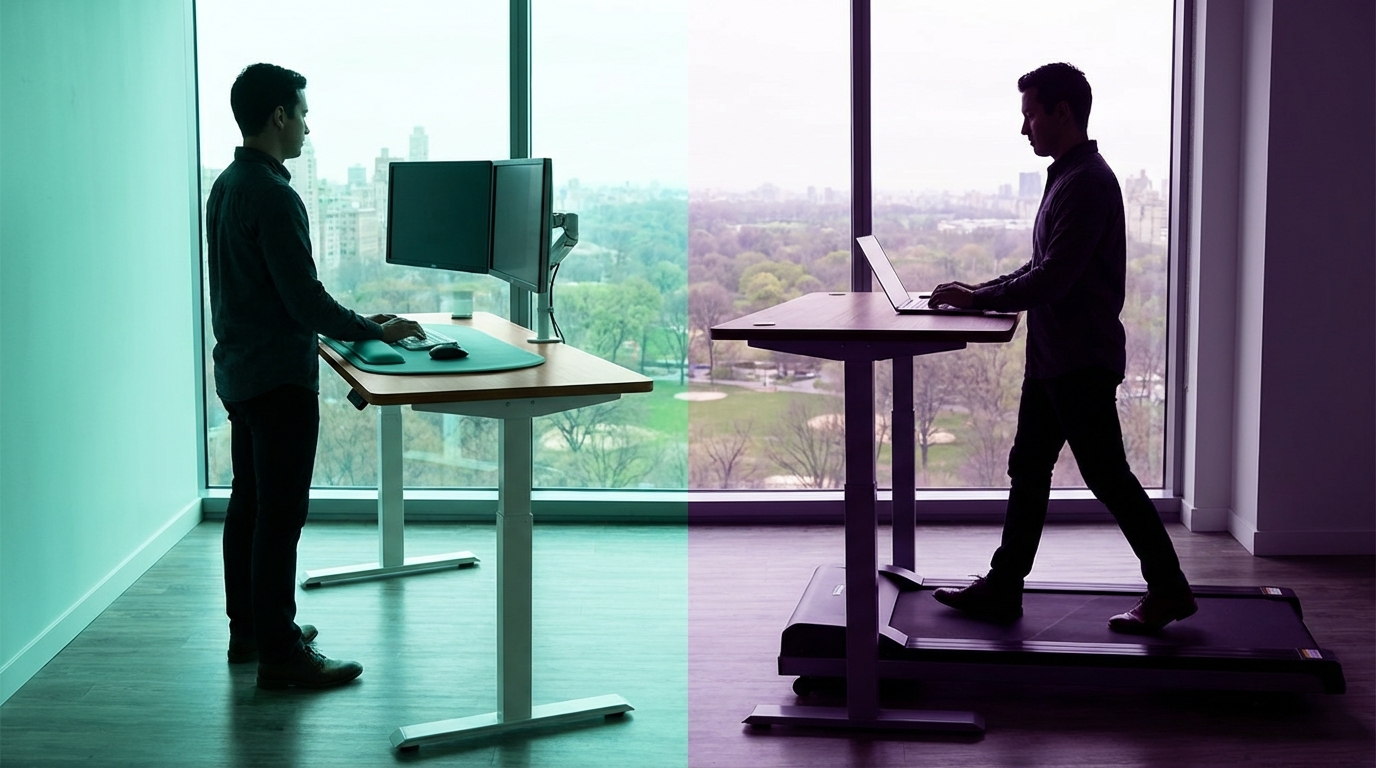
“The next big productivity gain in tech won’t come from AI. It will come from how long founders can keep their backs and brains working at 80%+ every day.”
Investors quietly track one metric that never shows up in a pitch deck: how long the founding team can stay sharp, focused, and injury free while grinding through 10 to 12 hour days. The market for standing desks and treadmill desks is a direct response to that pressure. The signal so far: standing desks deliver modest, measurable health and focus gains at a relatively low cost, while treadmill desks show strong health upside but mixed productivity results and real friction in actual startup use.
Most tech teams do not choose between standing and treadmill desks on features. They choose based on risk tolerance, space, and culture. Standing desks slide into a normal office with very little behavior change. Treadmill desks ask people to change how they work, how they talk, and even how they look on Zoom. The business value question is simple: does that extra movement translate into more output, fewer sick days, or sharper decision making that justifies the extra spend and friction?
The trend is not clear yet, but some patterns stand out. Standing desks have matured into a default line item in many Series A and later offices, priced and procured like monitors. Treadmill desks sit at the edge, more common in health-focused founders, remote power users, and a small group of knowledge workers who swear by them. The ROI picture depends heavily on job role, office layout, and how aggressively leadership pushes usage instead of letting the gear collect dust in a corner.
“Across multiple workplace studies, regular sit-stand rotation shows small drops in back pain and fatigue and small gains in self-reported focus, but not huge jumps in measured output.”
Health researchers see standing and treadmill setups as harm reduction for knowledge work. They do not turn a developer into an athlete, but they shift work patterns away from long, uninterrupted sitting, which is linked to higher risk for cardiovascular disease and metabolic problems. For a startup, the bet is that a healthier team means fewer injury claims, lower long-term absenteeism, and sharper meetings at 4 PM when decisions often go sideways.
Standing and treadmill desks also play a signaling role. Founders use them to send a message: “We invest in people.” Recruiters show them on office tours. Early hires talk about them on LinkedIn. The signal can help attract senior engineers who already worry about burnout and chronic pain. At the same time, a room full of unused treadmills tells a different story: a team that bought hardware instead of fixing workload, process, or meeting culture.
Why tech workers care about standing and treadmill desks
The tech industry created the perfect conditions for long sitting: powerful laptops, endless online collaboration, and a culture that treats “deep work” as a badge of honor. Many engineers, PMs, and founders sit 8 to 12 hours per workday, often with only short breaks between standups, code reviews, and calls.
From a business perspective, this matters for three reasons:
1. Health costs and absenteeism rise with chronic sitting and poor ergonomics.
2. Low-level fatigue and discomfort reduce cognitive capacity, especially late in the day.
3. Chronic pain drives attrition, which is expensive in a tight hiring market.
“One occupational health study found that knowledge workers who break up sitting every 30 minutes with light movement show better glucose control and less self-reported fatigue over a workday.”
The promise of standing and treadmill desks is simple:
– Stand more, sit less.
– Move a bit while working.
– Keep posture and joints in a safer range.
– Stay alert longer without adding caffeine.
For founders, the math looks like this: if one ergonomic intervention can keep a senior engineer productive for an extra year before burnout, or cut one spine surgery out of the team over a decade, the financial return dwarfs the cost of a few thousand dollars in hardware.
Standing desks: the default upgrade for tech offices
Height-adjustable desks have moved from “perk” to “expected” in many tech offices. They fit into open-plan layouts, work for both sitting and standing, and support almost every job function that relies on a keyboard and mouse.
How standing desks change daily work
Standing desks do not demand a new working style. They simply add one more posture option. Most people adopt a rotation pattern:
– 45 to 90 minutes sitting
– 20 to 40 minutes standing
– Repeat across the day
The market shows a clear usage pattern: very few employees stand all day. When teams receive good training, they treat standing as a posture tool, not a replacement for sitting.
From a performance angle, standing can:
– Reduce lower back pressure for some users.
– Increase slight movement (fidgeting, weight shifting).
– Improve alertness during long meetings or reading tasks.
Early adopters often report a “novelty boost” where standing feels great for a few weeks. After that, usage drops unless the desk is easy to adjust and habits are reinforced by culture. Auto presets, clear cable management, and stable frames matter more for sustained usage than most HR teams expect.
What the evidence says about standing at work
Research on standing desks shows modest, not dramatic, benefits. Key patterns:
– Small reduction in total sitting time across a workday.
– Reduction in back and neck discomfort for some workers.
– Little or no direct jump in measurable typing or coding speed.
One large office trial saw people sit about 60 to 100 minutes less per day when given sit-stand desks and coaching. That is meaningful at scale across years of work. Still, it does not convert to a 20% productivity jump. The value is more about long-term health and sustained comfort.
“Meta-analyses of sit-stand interventions show consistent drops in musculoskeletal discomfort and fatigue, but changes in objective performance measures are small and variable.”
For tech founders, the takeaway is clear: standing desks are not magic productivity tools. They are risk management tools. They slightly tilt the odds toward a healthier, more comfortable workforce that can keep shipping without chronic pain pushing people to physical therapy or early leave.
Business value and ROI of standing desks
The financial case for standing desks comes from several angles:
– Lower risk of chronic back and neck issues.
– Lower ergonomic claim rates in some regions.
– Strong recruitment signal for senior talent who have “seen it all.”
– Better fit with hybrid and remote setups where people mirror the HQ standard at home.
Cost per employee typically falls somewhere between a few hundred and around a thousand dollars, depending on brand and region. Spread over 3 to 5 years, that is a small line item compared with salary, benefits, and lost time from one preventable injury.
A simple ROI framing:
– If an engineer on 200,000 dollars total comp avoids 5 days of missed work over 3 years because they have less back pain, the company saves thousands in direct and indirect costs.
– If a candidate chooses your offer over another partly because your environment signals that you handle work sustainably, the desk paid for itself in one hire.
This is why many Series B+ offices now default to height-adjustable desks for everyone, not just senior leadership.
Treadmill desks: movement on the job, with tradeoffs
Treadmill desks add a moving belt under or next to a desk, letting someone walk slowly while typing, reading, or taking calls. They aim to turn part of a workday into low-intensity exercise.
Unlike standing desks, treadmill desks change how colleagues see and hear each other:
– Footsteps can add noise, either locally or over microphones.
– Body motion affects camera stability on video calls.
– Users must manage speed, balance, and posture while handling work tasks.
This creates a larger gap between “looks good in a wellness brochure” and “fits the way we actually work and talk.”
How treadmill desks affect work patterns
Most treadmill desk users settle around 1 to 2 miles per hour. Faster speeds make precise typing and mouse work harder and increase perceived effort. Common patterns:
– Walk during email triage, reading, planning, or async work.
– Stop or slow down during intense coding, debugging, or visual design.
– Pause for certain calls, especially sales calls or investor meetings.
Walking while working can raise heart rate into a light activity zone, especially for people who are otherwise sedentary. Over a full workday, this can add thousands of steps without separate gym time.
The tension: some tasks tolerate movement well (reading, brainstorming, basic support responses), while others suffer (pixel-perfect Figma tweaks, complex spreadsheet modeling, security audits).
What the evidence says about walking while working
Research on treadmill desks suggests:
– Significant reduction in overall sitting time.
– Increased daily energy expenditure.
– Mixed results for fine motor tasks and text entry.
A frequently cited pattern: people on treadmill desks tend to walk for 1 to 3 hours per day, not full workdays. They report feeling more energetic, but measured typing speed and accuracy often drop slightly while walking, especially early in adoption.
For tech roles, that nuance matters. Even a small drop in precision can hurt engineers or designers working on critical code or visual assets. Over time, many users adapt and recover some performance, but not always fully for the most detailed tasks.
Business value and ROI of treadmill desks
The upside case for treadmill desks:
– Stronger reduction in total sedentary time than standing desks.
– Higher calorie burn and better cardiovascular markers.
– Potential long-term reduction in metabolic disease risk.
The cost side:
– Higher unit cost per seat than standing desks alone.
– Extra noise and vibration management.
– Larger floor space needs.
– Lower adoption rates in shared open offices.
From a founder’s view, treadmill desks make sense when:
– The team is mostly remote or hybrid and can choose their own home setup.
– Space is not tight, and some private or semi-private zones exist for walkers.
– Culture supports visible movement and casual setups on calls.
Even then, the smart play tends to be targeted deployment. For example: offer treadmill desks as an opt-in perk for people who ask and have job roles that fit, like content writers, product managers, or analysts who do long stretches of reading and planning.
Standing vs treadmill: comparing value for tech teams
The two products attack the same core problem from different angles: reduce the harm from long sitting. The question is not only “Which is healthier?” but “Where do we see the highest return per dollar and per square foot in a tech office?”
Feature comparison: standing desk vs treadmill desk
| Aspect | Standing Desk | Treadmill Desk |
|---|---|---|
| Primary goal | Reduce sitting time, change posture | Reduce sitting time, add steady movement |
| Typical cost per user | Lower to mid (desk only) | Higher (desk + treadmill) |
| Floor space | Same as standard desk | More depth needed |
| Noise impact | Minimal | Low to moderate, depends on model |
| Learning curve | Low | Medium |
| Impact on fine motor tasks | Neutral or slight benefit from comfort | Small negative at walking speed |
| Health impact (sedentary time) | Moderate reduction | Larger reduction |
| Adoption rate in typical tech office | High if default | Low to moderate, often shared units |
| Perceived professionalism on calls | Normal | Mixed, depends on culture |
From this table, you can see why standing desks became the default ergonomic upgrade. They change behavior just enough to produce health and comfort gains, without forcing people to rethink how they interact with colleagues.
Treadmill desks produce larger physiological changes, but at the cost of friction, space, and sometimes team cohesion in tight environments.
Then vs now: desk setups in tech
The story of standing and treadmill desks makes more sense when you zoom out over the past two decades of office setups in tech and startups.
Early-2000s cubicle farms rarely had sit-stand options. Health narratives centered on carpal tunnel, not all-day sitting.
Today, remote work, Slack, and long Zoom days push bodies to new limits, and gear has shifted in response.
| Office Era | Then (mid-2000s) | Now (2020s) |
|---|---|---|
| Default desk type | Fixed-height desk | Height-adjustable desk in many tech offices |
| Ergonomics focus | Wrist support, basic chairs | Back health, posture variation, movement |
| Movement at work | Walk to meetings, printer, whiteboard | Meetings on video, far less natural walking |
| Treadmill desks presence | Rare novelty | Niche but visible in wellness-focused teams |
| Wellness program lens | Gym discounts | Integrated: mental health, ergonomic gear, schedule design |
The shift toward remote-heavy work increased the value of any in-place movement solution. Treadmill desks, while still niche, now make more sense in a world where “walking to a colleague’s desk” is no longer part of your step count.
Pricing models and purchase patterns
Founders and office managers usually face three economic models:
1. Company-owned hardware at HQ.
2. Stipends for home office setups.
3. Rental or leasing of ergonomic gear.
Here is how standing vs treadmill desks compare under these models.
| Model | Standing Desk | Treadmill Desk |
|---|---|---|
| Company-owned HQ | Common. Easy to standardize, bulk pricing. | Rare. Placed in shared wellness zones. |
| Home office stipend | Frequent choice by employees. | Chosen by a small, self-selecting minority. |
| Leasing | Offered by several furniture vendors. | Available but less common, higher per-unit cost. |
| Resale value | Moderate on secondary markets. | Lower; buyers worry about wear and hygiene. |
The financial risk of a standing desk that goes unused is modest. It still works as a normal desk. A treadmill that sees little use is more like a wasted gym membership, only larger and harder to hide.
What actually happens in real startups
Theory says: buy the healthiest gear and watch people thrive. Practice in many tech offices looks different.
Patterns that show up again and again:
– Standing desks used strongly for the first 3 months, then stabilized at moderate standing time.
– Treadmill desks used heavily by a few champions, rarely by the rest.
– Poor cable management and monitor arms making height changes a hassle, which kills standing habits.
– Remote employees improvising with boxes and DIY setups when stipends lag behind.
Founders who get better ROI from this gear do a few specific things:
– Pair equipment with guidance from an ergonomist.
– Set norms like “try standing for part of your 1:1s” instead of leaving it entirely to chance.
– Make movement acceptable during meetings, including camera-off walking when sound quality allows.
– Avoid shaming anyone who prefers to sit more because of medical or neurodivergent needs.
The culture piece matters as much as the hardware. No one wants to be the only person walking during the all-hands if side comments or jokes follow. On the flip side, a leader who occasionally takes a low-stakes meeting while walking sends a permission signal.
Which roles gain the most from each setup
ROI also depends on what people actually do all day.
Standing desks by role
– Engineers and data scientists: benefit from posture variation and back relief, with negligible downside.
– Product managers: long meetings and context switching make standing helpful to avoid afternoon slumps.
– Designers: standing during critiques or reviews can help energy, but precise work still favors sitting part of the time.
– Sales and customer success: standing helps during calls for vocal projection and engagement.
The main risk is fatigue from over-enthusiastic standing. New users often try to stand all day and burn out their feet and knees. Training should stress rotation, not heroics.
Treadmill desks by role
– Content and marketing writers: strong fit for drafting, ideation, and reading competitor material.
– Analysts: reading-heavy work blocks pair well with slow walking.
– Support agents on chat or email: workable if noise and focus are managed.
For high-focus, high-precision roles, treadmill usage tends to cluster around lower-stakes tasks and off-peak hours.
Where hype exceeds reality
The wellness market sometimes sells standing and treadmill desks as silver bullets for weight loss, productivity, and creativity. That framing sets teams up for disappointment.
Realistic expectations:
– Weight loss from a standing desk alone is small. People often compensate by sitting more after work or eating slightly more.
– Treadmill desks can increase daily calorie burn by a few hundred calories when used consistently, but that still needs diet and broader activity habits to create sustained change.
– Creativity gains are more about avoiding fatigue and mental fog rather than suddenly becoming more original.
For a startup, the bigger risk is narrative inflation:
– “We bought treadmill desks, so our wellness program is done.”
– “Engineers have standing desks, so long hours are fine.”
Gear does not fix broken planning, unrealistic deadlines, or constant context switching. It supports people once load and workflows are already sane.
Signals and brand value in the talent market
Physical workspace still matters for companies with any office presence. Photos of ergonomic setups, light-filled rooms, and flexible work zones travel fast on LinkedIn and in Slack channels among candidates.
Standing desks signal:
– Modern office standards.
– Basic respect for employee comfort.
– A company spending at least some budget on physical work conditions.
Treadmill desks signal:
– A stronger tilt toward health-focused culture.
– A willingness to tolerate a bit of weirdness to support well-being.
The key is authenticity. A single treadmill in a corner, never used, reads as decoration. A mix of gear, regular usage, and honest communication about what works and what does not reads as credible.
Reducing risk and making the right call
If you are deciding what to roll out, a staged path often works best.
Phase 1: Standardize on good height-adjustable desks, chairs, and monitor arms. This sets a strong baseline and helps almost everyone.
Phase 2: Add a small number of shared treadmill units in opt-in zones or support employees who self-select a treadmill desk for home setups, especially if their roles fit.
Phase 3: Collect light data: self-reported comfort, usage patterns, and any reduction in ergonomic complaints over time.
If the data shows that your team loves walking and uses treadmills heavily, expand. If not, keep them as a niche option and double down on cheaper, broader measures like movement breaks, walking meetings, and calendar norms that allow people to stand and stretch.
At the end of the day, the real question is not “Are standing desks or treadmill desks worth the hype?” The sharper question for tech and startup teams is: “Which mix of posture options, movement tools, and culture gives my people the energy and health span to keep building for years without breaking their bodies in the process?”