
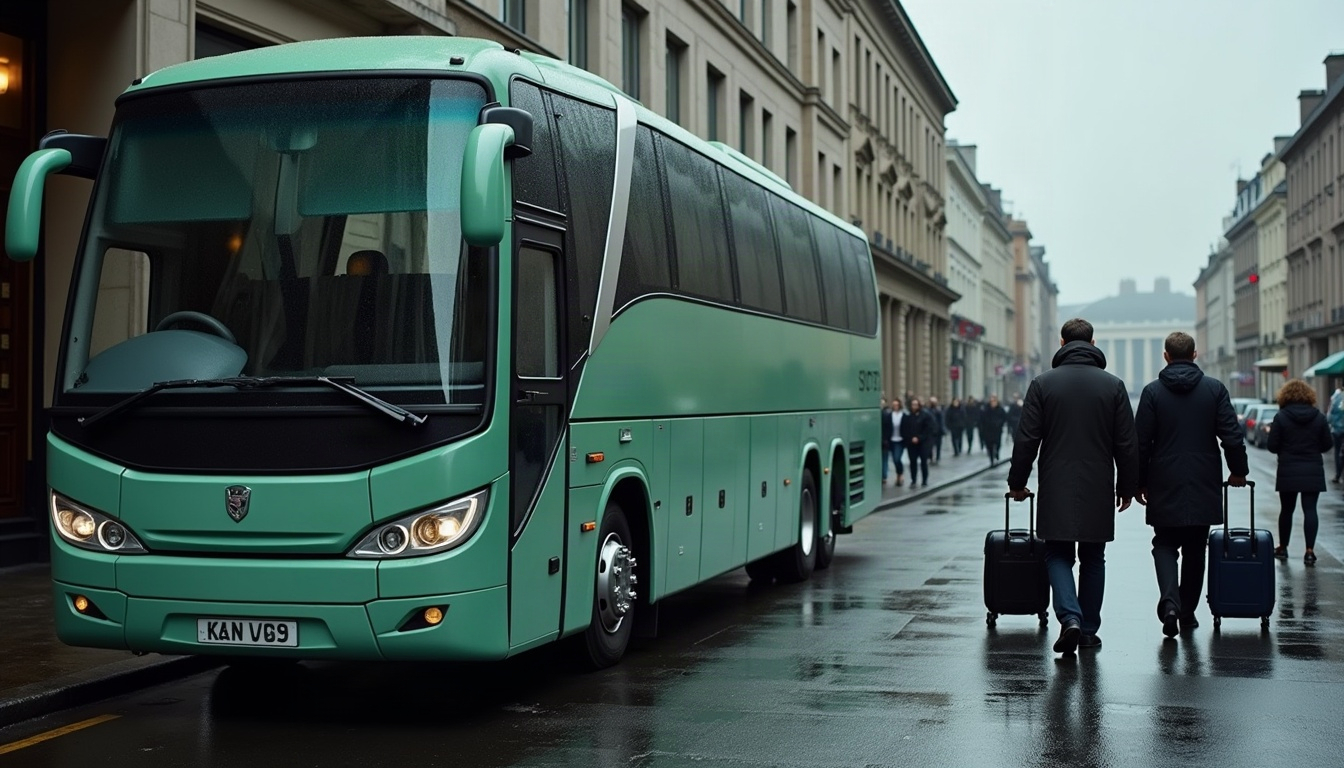
Irish startups are arriving in the United States as a team more often than as a lone founder with a suitcase and a stack of business cards. A sales lead, a couple of engineers and sometimes the whole company land in a city none of them know, then have to get from the airport to a hotel to a meeting to dinner, on time and together. Local pages for wedding bus transportation Denver usually spell out pickup points, group sizes and timings, and that happens to be a decent checklist for a business trip too.
It sounds like a logistics footnote, and it is exactly the sort of footnote that eats a founder’s week. Our read is that moving a group on the ground is a real decision with a build-or-buy answer, like any other, and that the people who know most about it are the ones who move large, nervous, fixed-schedule parties for a living. We will use Denver as the worked example, make the case for buying, and finish with the questions to ask before you do.
Going to the US now means going together
Ask a founder who has done it what the first American trip looked like and the story is usually about one person: a rented car, a week of back-to-back coffees, a sat nav with opinions. That version still exists. But the group version is common enough now to deserve a plan. Offsites, customer visits, trade events and the odd board gathering all involve a handful to a dozen people who need to be in the same place at the same time, often straight off a long flight.
Denver makes a good example because it is a city that spreads out. Its airport sits well outside town, the business districts and hotels are scattered, and the mountains that make the place famous are a drive away. Public transport exists, but a team carrying laptops, demo kit and jet lag is not its ideal customer. The default answer, three rental cars and a shared spreadsheet, falls apart quickly.
The person who ends up organising all this is rarely the one who was hired to. It tends to be the most junior colleague, or the most helpful one, and neither of them volunteered. Which is the first sign that the task has not been priced in.
The Irish angle
Ireland’s home market is small enough that ambitious startups look abroad early, and the United States is the obvious first target: the same language, an enormous market and a Dublin that hosts the European bases of plenty of American tech firms, so the connection already feels close. State agencies such as Enterprise Ireland have long backed that outward push in general terms. What life at home never teaches is American distance. A journey that is one train and a short taxi in Ireland becomes an hour behind a windscreen, on the wrong side of the road for anyone used to driving on the left.
Build or buy applies to the ride from the airport too
Founders know the build-or-buy argument by heart when it concerns software. Few apply it to a vehicle. Building means everyone arranges themselves: rental cars, ride-hailing apps, a group chat that says “running late” at the worst possible moment. Buying means one booked vehicle and a professional driver, with the group arriving as a group.
On a spreadsheet, building wins. The rental rates are visible, the ride-hailing fares look small and the booking takes five minutes. Our view is that the real cost of getting a team around is the time it takes to get everyone into the same place, and nobody puts that in a column. Add the parking, the wrong turns, and the colleague who has been awake since the previous morning and is now expected to drive on the right, and the cheap option begins to look like a loan with an unusually flexible repayment date.
None of this is an argument for buying every leg. An evening with no fixed time can stay loose, and a founder who wants to wander back to the hotel on foot should be allowed to. It is the arrival, the day with the customer meeting and the dinner with a hard start that earn their booking.
A wedding is the best model for a team trip
Few events are as unforgiving as a wedding. The ceremony starts when it starts, the party has to arrive together and looking presentable, there is luggage, and there is a long list of people who each have something else on their mind. Transport firms that serve weddings plan around exactly those constraints: a fixed timetable, a headcount that changes the week before, pickups from more than one place and a firm drop-off time. A startup team arriving for a first customer meeting has the same problem in a smarter jacket, and the people who plan wedding transport already own the checklist.
The table below is our quick comparison of the two ways to move a group, with the honest losses included.
| What matters | Everyone fends for themselves | One booked group vehicle |
|---|---|---|
| Arriving together | Rarely, and never on a bad day | The whole point of it |
| Knowing the cost | Looks low, drifts as the week goes on | Can be fixed in writing before you travel |
| Driving on unfamiliar roads | Falls to whoever drew the short straw | Handled by a professional driver |
| Changing the plan on the day | Easy, because everyone just goes | Needs a call to the operator |
A wedding does not forgive a late vehicle, and neither does a first meeting.
The bottom row is the genuine cost of buying. A booked vehicle runs to a timetable, so a team that likes to improvise will feel the leash. We think that trade is worth making for the legs that matter and not worth making for the rest, which is why the decision should be taken leg by leg and not as a blanket policy.
What to ask before you book anything
Any operator worth hiring will answer these without fuss, and the answers belong in writing, not in a friendly phone call that nobody remembers a week later. A short list, since the questions do the work.
The timetable
Find out what happens when a flight lands late. Ask how long the vehicle will wait, whether waiting time is in the quote, and who you call if the plan moves. Give the operator flight numbers and meeting times, not just a headcount.
The vehicle
Check the seat count against the real group, with luggage. Laptops, a roll-up banner and a box of demo hardware take up more room than people expect, and the airport transfer is the worst moment to discover it.
The paperwork
Ask the operator to show their licence and insurance cover, and read the cancellation terms before you pay a deposit. If you are unsure which rules apply to a hired vehicle with a driver, the relevant local authority can say, and a solicitor can read the contract before you sign it.
The weather and the route
If the trip heads into the mountains, ask how the operator handles snow and road closures in winter. A good one will have a plan and will say so without being asked twice.
What next
- Give ground transport its own line in the trip budget, before the flights are booked and not after the invoices arrive.
- Decide build or buy leg by leg. Airport transfers and anything with a fixed start time are worth buying; free evenings can stay loose.
- Send the operator flight numbers, meeting times and the real headcount, and ask for the booking terms in writing.
- Name one person on the team as transport owner, with the operator’s number saved in their phone before the plane takes off.
- Leave a buffer between landing and the first meeting. Nobody has ever regretted arriving early with a coffee in hand.
Buy the ride, build the pitch, and let someone who knows the road do the driving.