
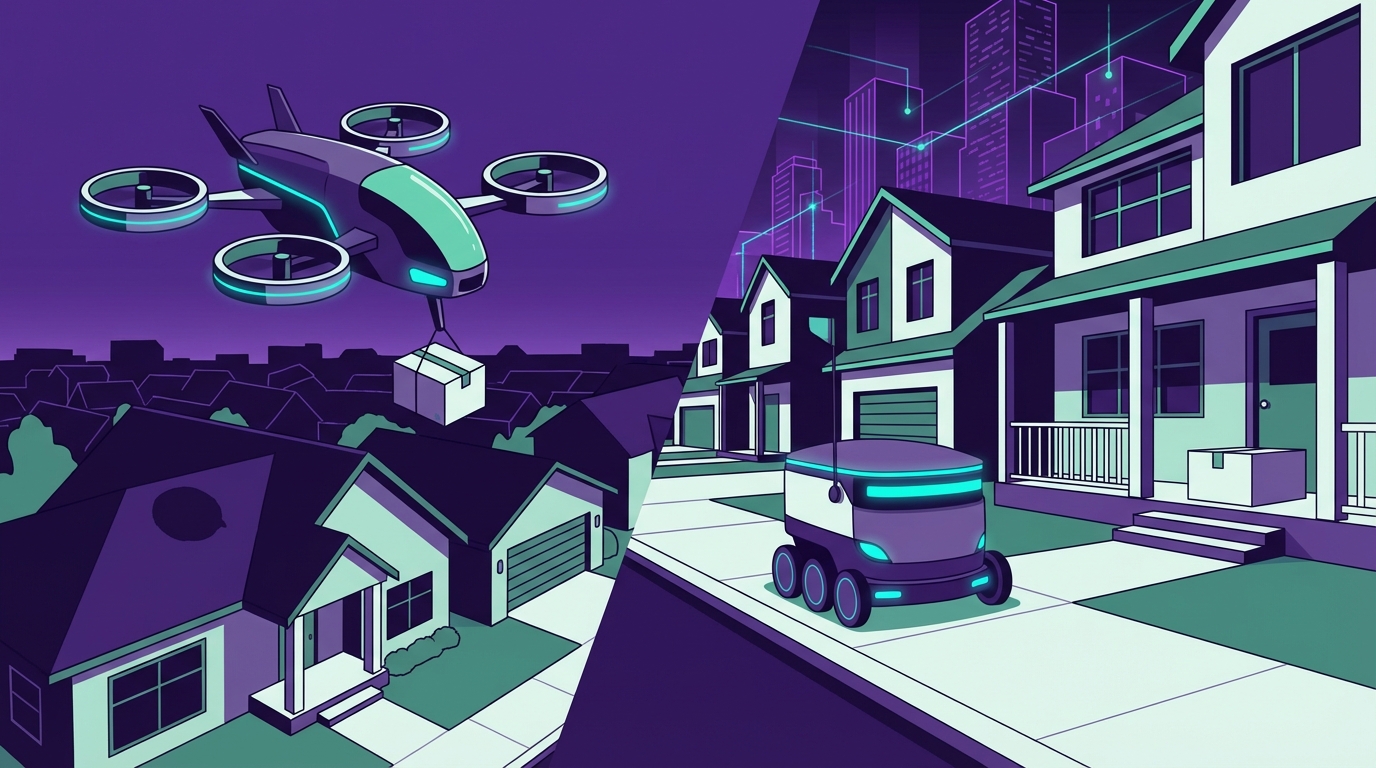
“The winner in last-mile delivery will not be the fastest machine. It will be the cheapest one that customers quietly trust.”
Investors are betting that autonomous delivery can cut last-mile costs by 40 to 60 percent, but the market is still arguing over which hardware wins that margin race: drones in the air or robots on the ground. Capital is flowing into both, regulators move slower than founders want, and the unit economics are only now starting to come into focus.
The market treats last mile as the most expensive part of the logistics chain. Roughly half of total shipping cost happens in the final few kilometers. That single line on a P&L is why you see venture money, corporate labs, and city regulators all watching the same experiments in suburban neighborhoods and dense urban blocks. For founders, the key question is not “which looks cooler,” but “which hits positive contribution margin first, at scale, without breaking local rules or customer trust.”
The trend is not clear yet, but the contours are emerging. Drones promise speed and direct routing. Ground robots promise lower regulatory friction and higher payload at lower energy cost. Both pitch higher delivery frequency and lower labor spend. Both claim better data on customer behavior at the doorstep. The real story sits in the tradeoff between capex, opex, and constraint: airspace rules vs sidewalk rules, battery size vs payload, weather sensitivity vs uptime, routing density vs unit cost.
The business case: where last-mile costs actually sit
Traditional van-based last-mile delivery stacks cost in three places: driver wages, vehicle fuel and maintenance, and time lost to traffic and parking. Autonomy attacks each of these.
Investors look for two numbers in every last-mile deck: cost per delivery and deliveries per hour per asset. The math is simple. If you can lift deliveries per hour and drive cost per hour down, margins widen. If drones or robots cannot beat a human driver on those two metrics in a specific geography, the pitch collapses.
For context, legacy last-mile cost per parcel in dense cities sits roughly between 3 and 7 dollars, depending on wages, congestion, and route density. In low-density suburbs, it can climb above 10 dollars. The thesis around autonomous delivery is that a mature fleet can drop that to 1 to 3 dollars per parcel in the best zones.
“In real pilots we see 20 to 30 percent cost savings at small scale. The 50 percent number only appears once routing density is high and asset utilization is above 16 hours a day.”
That quote could describe both drones and sidewalk robots. The difference shows up when you unpack constraints: where can they actually operate 16 hours a day, what payloads make sense, and which regulatory regimes slow them down.
Retro specs: where we came from (2005 vs now)
To understand where drones and robots might go, it helps to look at where delivery technology was in 2005 and what has changed.
In 2005, “autonomous delivery” looked like:
“In 2005, the smartest last-mile ‘tech’ most couriers had was a barcode scanner, a rugged Nokia, and printed routes highlighted with a marker.”
Carrier software was crude. GPS on phones was basic. Real-time routing was rare outside large integrators. Most small couriers ran on paper manifests and experience inside the driver’s head.
Here is a simplified comparison of tech and economics around last mile in 2005 vs the current generation of autonomous pilots:
| Metric | 2005 Van Courier | 2025 Autonomous Pilot (Drone/Robot mix) |
|---|---|---|
| Navigation | Static maps, driver knowledge, limited GPS | High-precision GPS, SLAM, HD maps, remote ops centers |
| Route planning | Manual routing, batch planning each morning | Continuous algorithmic routing, real-time re-optimization |
| Tracking visibility | Package-level scans at depot checkpoints | Real-time positional data per asset, per stop |
| Average payload per trip | 80 to 150 packages in a van | 1 to 6 packages per autonomous run |
| Cost per stop (dense city) | 4 to 8 USD | Projected 1 to 3 USD for optimal autonomous zones |
| Decision speed | Daily planning cycles | Sub-minute, data-based rerouting |
Another way to see the historical jump is to look at consumer devices. The phones that drivers and customers carried in 2005 shaped what was possible.
| Feature | 2005: Nokia 3310 era | 2025: Flagship smartphone |
|---|---|---|
| GPS accuracy | Limited or external GPS, coarse positioning | Multi-band GNSS, meter-level or better in most zones |
| Data connection | 2G/early 3G, low bandwidth | 5G and strong 4G, high bandwidth, low latency |
| Camera use in logistics | Rare, low-res photos at delivery | High-res proof-of-delivery, computer vision at edge |
| Consumer tracking expectations | “Out for delivery” SMS or web page update | Live map tracking, minute-level ETA updates |
“User reviews from 2005 read like a different era: ‘Package came sometime today while I was out, no idea when, but at least it arrived.’ That tolerance is gone.”
This historical context matters for drones and robots. Customers now expect precise ETAs and real transparency. Cities expect operators to prove safety with data. These expectations change the ROI math, because any solution that cannot feed high quality telemetry into customer apps and city dashboards will face resistance.
Drones vs robots: core economics of last mile
Autonomous drones and sidewalk robots are both trying to carve out territory in the same chain: warehouse or dark store to doorstep or pickup point. The business value shows up in a few common buckets:
– Lower labor spending per delivery
– Higher delivery frequency and tighter delivery windows
– New delivery time bands (late night, early morning) with lower incremental cost
– Better route and customer data for merchandising and pricing
The tradeoffs show up across several axes. At a high level, you can think about them like this:
| Dimension | Delivery Drones (Air) | Sidewalk/Street Robots (Ground) |
|---|---|---|
| Capex per unit | Higher (complex avionics, safety systems) | Moderate (sensors, drivetrain, but simpler framework) |
| Operating cost per km | Low energy use, but higher regulatory overhead | Low energy, lower regulatory overhead in many cities |
| Payload | Typically 1 to 5 kg | Often 10 to 20+ kg |
| Range | Several km per flight, direct line paths | Similar or higher, constrained by streets/sidewalks |
| Speed | High, mostly independent of traffic | Low to moderate, heavily influenced by pedestrians/cars |
| Regulation | Aviation authorities, airspace control, BVLOS constraints | Local city rules, right-of-way, sidewalk access rules |
| Deployment zones | Best in low-density or semi-rural areas | Best in campuses, suburbs, and some cities |
| Customer perception | High novelty, more noise concerns | Less visible overhead, but privacy concerns at street level |
From a P&L point of view, drones are a better fit for:
– Sparse environments
– Time-sensitive orders
– Hard-to-reach addresses where road networks are poor
Robots are a better fit for:
– Dense or semi-dense zones
– Short-range but high frequency orders, like food delivery or q-commerce
– Environments like campuses, business parks, and new developments with clear pathways
The key word across all of this is “fit.” There is no single winner. The winners are networks that match vehicle type to zone, order type, time of day, and weather.
Regulatory friction vs margin potential
Regulation is not just a compliance burden. It shapes where and when these assets can run, and that shape flows straight into margin.
For drones, the central issues are:
– Beyond Visual Line of Sight (BVLOS) permissions
– Operating over people and property
– Noise limits
– No-fly zones around airports, critical infrastructure, and some neighborhoods
Every boundary cuts into the addressable market. A drone network that cannot fly BVLOS is basically stuck in tiny pockets, with poor utilization. That hurts asset turns and increases cost per delivery.
Ground robots face:
– Sidewalk access rules
– Speed limits
– Requirements for remote human oversight
– Liability rules for collisions or obstruction
Some cities welcome small delivery robots. Others either ban them or limit them to narrow pilot zones. For founders, this means go-to-market strategy is often city-by-city lobbying combined with careful pilot data sharing.
From an investor lens, a startup that shows strong unit economics in one “friendly” city but no traction anywhere else will face hard questions. Networks need geographic diversity to smooth regulatory risk.
Retro user reviews: how expectations tightened
Customer perception shapes repeat usage, which then shapes the volume needed to reach good economics.
Look at the tone shift between mid-2000s delivery reviews and current ones.
“User review, 2005: ‘Package came a day late but customer service answered my call and that worked for me.'”
Contrast that with what customers say today about experimental autonomous pilots:
“User review, 2024: ‘Robot delivery said 18 minutes and it arrived in 21. That’s fine. What I care about is that my food was still hot and the ETA updates looked accurate while it stopped at crosswalks.'”
The bar has moved from “eventual delivery” to “reliable window and condition.” Autonomous systems must hit that bar or exceed it. The tech novelty only buys one or two tries.
From a business point of view, this matters for:
– Churn rates in subscription plans for fast delivery
– Willingness to pay small surcharges for specific time windows
– Conversion on “express” or “priority” options that might rely on drones
User tolerance for failure is low. That pushes operators to invest heavily in routing intelligence, remote ops, and fallback paths, which shows up as fixed cost in the business model.
Unit economics: drones vs robots in practice
To evaluate any operator, you want to break unit economics into:
– Fixed cost per asset (purchase, financing, depreciation)
– Variable cost per trip (energy, maintenance, connectivity, depot handling)
– Oversight and control room cost per active asset
– Shared overhead
Then you look at:
– Average trips per day per asset
– Average payload per trip
– Revenue per order
The picture is very different between drones and robots.
For drones:
– Hardware is more expensive per unit.
– Maintenance windows can be longer.
– But they can cover more trips in some zones because they fly direct routes and bypass traffic.
For robots:
– Hardware is cheaper.
– Trips are slower.
– In dense areas, a robot might still cover enough stops per hour because distances are short and many orders are clustered.
Some operators model a drone performing 15 to 25 deliveries per day in a semi-rural environment, while a robot in a high-density campus area might handle 20 to 40 short hops.
If average delivery revenue per order is, say, 3 dollars in fees paid by merchants and consumers, and you subtract a variable cost of 1 dollar, the rest needs to cover asset cost and overhead. Hitting that balance takes either high daily volume per asset or a higher revenue per delivery for urgent time slots.
Pricing models: who pays and how much
Different companies structure pricing differently. The models usually sit across three layers:
– B2B contracts with merchants or platforms
– Delivery fees to end customers
– Subscription or membership fees for “free” or discounted delivery
Here is a simple comparison of how pricing might look for a drone-focused network vs a robot-focused network serving the same city:
| Pricing Dimension | Drone Network | Robot Network |
|---|---|---|
| Merchant fee per order | 1.50 to 3.00 USD for standard; higher for time-critical | 1.00 to 2.50 USD, often for short-range food/grocery |
| Customer delivery fee | 0 to 5.00 USD depending on speed and window | 0 to 3.00 USD; often lower average ticket size |
| Subscription model | Monthly fee for “unlimited drone delivery within zone” | Bundles with food apps or grocery memberships |
| Peak pricing | Surge for weather risk or high-demand windows | Surge during mealtimes or event spikes |
| Target margin per order | 20 to 30 percent contribution margin at scale | 15 to 25 percent, offset by higher volume density |
The key question: who captures the value of “faster and cheaper”? In many current experiments, large platforms absorb early losses to gain data and brand differentiation. Long term, though, the operators need a path where price does not race to the bottom as soon as multiple networks compete in the same zip codes.
Then vs now: legacy courier vs autonomous fleets
To understand appeal for merchants and investors, it helps to line up legacy 2005-style courier services against a modern mix of vans, drones, and robots.
| Aspect | 2005 Local Courier Service | 2025 Mixed Autonomous Fleet |
|---|---|---|
| Order placement | Phone or fax, manual data entry | API-first, integrated with e-commerce, food, and grocery apps |
| Routing | Dispatcher experience, static daily runs | Software orchestration across vans, robots, drones in real time |
| Delivery window accuracy | Half-day windows, unpredictable traffic impact | 30 to 60 minute windows, real-time ETA updates |
| Proof of delivery | Paper signature or basic scanner log | Images, telemetry, precise coordinates, tamper detection |
| Cost transparency | Opaque pricing, manual invoices | Per-order pricing, analytics dashboards for merchants |
| Service times | Business hours, some extended options | Longer day coverage, especially with autonomous assets |
This contrast explains why both startups and incumbents chase autonomy. It is not just labor savings. It is deeper control over the entire customer promise, with data that feeds everything from inventory positioning to marketing offers.
Drones: strengths, weaknesses, and where they fit
Where drones shine
Drones offer three strong economic levers:
1. Path efficiency
Drones ignore road networks. They fly almost straight lines between depots and delivery points. This trims distance and time, especially in suburbs with winding roads or poor street layouts.
2. Traffic independence
Road congestion does not slow a drone. That is attractive in cities where van productivity drops sharply at rush hour.
3. Speed for high-value orders
Some segments place real value on speed: urgent medical supplies, critical components, hot meals with high ticket size. For these, operators can charge a premium that offsets higher asset cost.
Drones also open some new markets: remote communities, areas with weak road infrastructure, and cluster delivery to outlying suburbs from centralized hubs.
Where drones struggle
The constraints are serious:
– Payload limits restrict them to small orders.
– Noise concerns can trigger resident complaints at scale.
– Landing zones are tricky in dense apartment blocks.
– Bad weather (strong wind, heavy rain) reduces uptime.
Every one of these limits forces operators to narrow which orders they accept and where. If a drone fleet spends too much time idle because of weather or regulatory restrictions, the economics suffer.
Robots: strengths, weaknesses, and where they fit
Where robots shine
Ground robots work best where:
– Distances are short.
– Sidewalks are wide and continuous.
– Many orders cluster in dense areas, like apartment complexes or workplaces.
The strongest points:
1. Payload vs cost
Ground units can carry multiple orders and heavier items without huge jumps in cost. This fits grocery, mid-size retail items, and bundled deliveries.
2. Lower regulatory barriers in some regions
It is often easier for cities to permit small sidewalk robots than to open urban airspace. That speeds up go-to-market.
3. Social acceptability
People see them on sidewalks. The novelty fades but acceptance stays high if incidents stay low. Noise is minimal compared to drones.
Robots lend themselves to slow but steady operations with strong route density: exactly what many food and grocery partners want for short-range fulfillment.
Where robots struggle
Ground units are highly constrained by:
– Terrain (stairs, curbs, poorly maintained sidewalks)
– Pedestrian crowds
– Crossing busy intersections
– Vandalism or theft concerns in some areas
Traffic, even on sidewalks, sets a hard ceiling on how many deliveries per hour a robot can hit. That ceiling becomes painful in very dense cities.
Tech stack and data advantage
Both drones and robots run on layered stacks:
– Perception: cameras, lidar, radar, ultrasonic sensors
– Localization: GPS plus local mapping
– Planning: motion planning, route selection
– Control: low-level motors and flight control
– Connectivity: cellular, sometimes Wi-Fi at depots
– Operations: remote intervention systems
From a business view, the real defensibility often sits in:
– The quality of routing and fleet management software
– The quality of data integration with partners
– The ability to forecast demand and pre-position assets
Hardware can be cloned. The tech and operations stack that turns a fleet into a predictable, cost-effective network is harder to copy. This is where many founders position their company: “hardware-agnostic autonomy and logistics orchestration,” even if they start with one specific platform.
The ROI question: when does this make money
Investors look for a path where:
– Cost per delivery undercuts human couriers in at least a few well-defined zones.
– There is evidence that cost will continue to drop with scale.
– Churn is low enough that marketing spend per new user does not erase margin gains.
The model often assumes:
– High asset utilization: long daily operating hours, with good order density
– Learning curves that reduce incident rates, which cuts insurance cost
– Platform deals that lock in volume from large merchants
The risk is that these assumptions do not hold outside pilot environments. A robot network that looks strong on a university campus might not translate to a chaotic, mixed-use urban neighborhood. A drone network that works in a lightly populated suburb might not scale into tougher regulatory zones.
Who wins: single modality vs mixed fleets
Looking at the numbers, a pure drone or pure robot network will struggle to cover all the use cases that a modern logistics partner wants: everything from bulky weekly groceries to small urgent pharmacy orders.
More credible long-term models look like mixed fleets, where:
– Vans or e-bikes handle base load and bulky items.
– Robots handle high-frequency, short-range deliveries with good sidewalk access.
– Drones handle premium or remote deliveries where their speed and path independence really matter.
The orchestration layer decides in real time which asset type to assign. That layer becomes the real product. Hardware partners can change. The control system, data, and merchant integrations stay.
What founders should measure
For operators, clear metrics guide decisions better than broad promises. Some of the most useful ones:
– Asset utilization: active delivery time per asset per day
– Incident rate: safety issues per thousand trips
– Uptime per zone: percentage of hours where the fleet can operate
– Cost per delivery bucketed by zone, payload, and time of day
– Customer repeat usage and NPS segmented by delivery mode
Comparing drones vs robots through these lenses in specific test zones gives a more honest picture than general claims about which is “better.”
How merchants decide between partners
Merchants care less about rotor count and wheel design and more about:
– On-time delivery rate
– Impact on basket size and purchase frequency
– Delivery fee sensitivity among their customers
– Reliability during peaks
– Integration friction with their current systems
Those that tested basic courier services in 2005 and then shifted to app-based platforms over the next decade already know how quickly a “better” option can change their operations. Autonomy is another such shift, but the tradeoffs this time involve not only margin and customer experience, but also brand risk if something goes wrong on a sidewalk or in the air.
The final picture is not drones versus robots as a single global contest. It is drones and robots segmented by city, neighborhood, and use case, slotted into complex logistics networks that also still rely on humans, vans, bikes, and static pickup points. The companies that win are those that understand where each tool adds real business value and where it quietly destroys ROI.