“The next trillion-dollar blockchain application will not be a coin. It will be a supply chain ledger that never sleeps and never forgets.”
The market is quietly shifting blockchain spend from pure crypto speculation to traceability, trade finance, and compliance. Vendors pitch pilots at 50k to 250k, but large manufacturers now sign multi-year contracts in the low millions because they see a clear path to lower working capital, fewer counterfeits, and cleaner audit trails. The technology still carries hype baggage from the crypto boom, yet investors now ask a simpler question: can this chain of blocks cut my cost of goods sold by 1 to 3 percent or reduce recall risk by half?
For supply chains, that is a serious number.
The early story of blockchain in logistics came from conference stages and glossy decks, not from shipping docks. Startups promised tamper-proof ledgers for everything from tomatoes to titanium. Most pilots stopped at press releases. The friction sat less in the code and more in the contracts. Who pays to onboard suppliers? Who owns the data? Who is liable when the ledger says one thing and the warehouse shows another?
The trend is shifting. Procurement teams do not buy “blockchain.” They buy shorter cash cycles, lower fraud exposure, and fewer manual reconciliations. When you listen to how buyers talk now, the phrase “transparent, shared record” lands better than any talk of consensus protocols.
Investors look for one metric: conversion from pilot to production, and from a single trade lane to a full regional rollout. The signal is not the number of nodes. It is whether a Fortune 500 moves real purchase orders, invoices, and customs documents over a blockchain-backed system and then renews the contract.
The promise is simple on paper. Supply chains run on records: who shipped what, when, at what temperature, under what contract. Most of those records still live in PDFs, emails, and Excel, passed between enterprise resource planning (ERP) systems that rarely talk cleanly. The current setup burns time and working capital. Every reconciliation delay keeps cash locked. Every missing record increases legal exposure.
Blockchain does not magically fix broken procurement. It gives you a shared, append-only log that every party can read and validate. The trend is not clear yet, but the projects that survive share one common trait: they pick one business case with direct financial upside, and they avoid turning the entire operation into a Web3 science project.
“Early blockchain pilots in supply chains failed when they started with ideology instead of a payback period. The winning ones now start with invoice disputes, recalls, or counterfeits and work backwards.”
Why supply chains care about blockchain at all
Supply chains are not short of software. There are ERPs, transport management systems, warehouse systems, quality systems, and customs portals. So why add blockchain to the stack?
The answer sits in three gaps that keep showing up on CFO dashboards:
1. Data consistency across organizations
2. Proof of origin and handling
3. Trust in documents that trigger payment
Traditional databases work well inside one company. Once data crosses company borders, you rely on EDI, emails, and portals. This creates three business problems.
1. Shared truth between companies
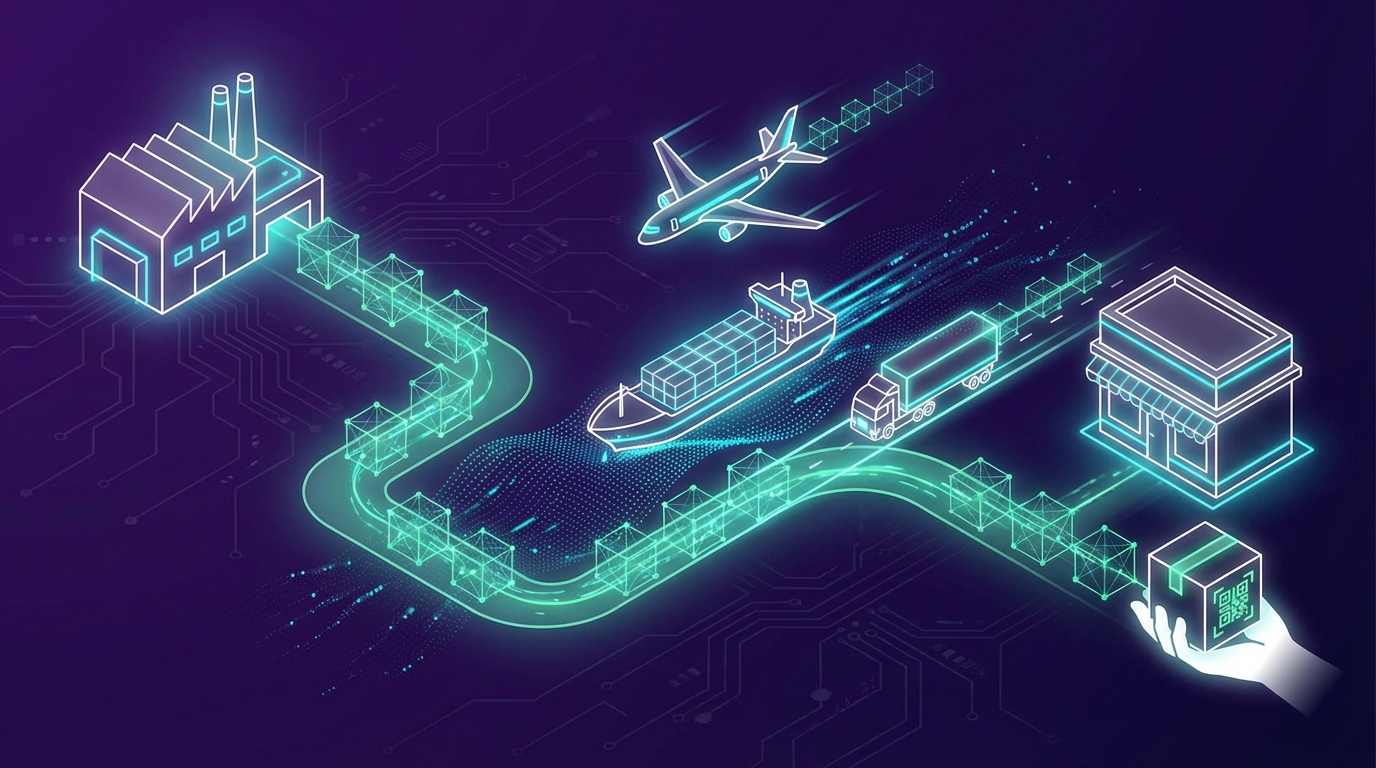
The hardest part of a modern supply chain is not tracking a pallet in a single warehouse. It is making several companies agree that a handover happened in a certain condition at a certain time.
Today the record of a shipment lives in multiple systems:
– The carrier logs an event in its tracking tool
– The shipper updates an ERP
– The freight forwarder manages a separate portal
– Customs keeps its own record
If there is a dispute, each party prints screenshots and PDF receipts. Lawyers sort it out. This delays payment and adds cost.
A blockchain-backed ledger can store key events in a shared format. Each participant writes entries and others can verify them. The ledger does not replace ERPs; it acts as a reference point. When all parties read from the same event log, dispute windows shrink.
The business value shows up as:
– Fewer disputes that reach legal teams
– Faster trade finance approvals
– Lower cost of reconciliation staff hours
2. Proof of origin and chain of custody
Regulators, brands, and consumers care about where products come from and how they move. This is no longer just a marketing line. Laws on forced labor, environmental claims, and product safety now carry real penalties.
Typical traceability methods rely on:
– Paper certificates
– Batch IDs in internal systems
– Occasional audits
Fraud finds those gaps easily. Certificates can be forged. Audits are episodic. Data can be altered without a tamper trail.
With blockchain, each handover event (harvest, processing, packaging, shipping) can be written as a transaction with time, location, and batch information. Devices like temperature sensors and GPS trackers can send signed events as well.
This does not guarantee that every entry is honest. Bad data can still be written. The key change is that altering old entries without detection becomes much harder, because records are chained and distributed.
Investors look for this traceability angle in sectors with tight regulation: pharma, aerospace, food, and critical minerals. In those sectors, a recall or non-compliance fine can wipe out the cost of a blockchain deployment many times over.
3. Trust in trade documents and payments
Global trade still runs on documents that have legal force: bills of lading, letters of credit, inspection reports. Many of these sit in PDFs or even paper files.
Banks and insurers charge high fees partly because they face fraud and documentation risk. A forged bill of lading or double-financed invoice creates real loss.
By anchoring document hashes and status changes on a blockchain, a bank can check whether:
– A bill of lading exists in a recognized ledger
– The same invoice has been used to secure multiple loans
– A document was altered after issuance
The business value is higher loan approval rates, shorter decision time, and lower fraud losses. For exporters, this can reduce the discount rate on receivables.
“We did not fund blockchain because it was trendy. We funded it because if we cut document fraud by even 0.1 percent of trade volume, the ROI pays for an entire portfolio of projects.”
Key supply chain use cases beyond crypto
The most credible blockchain supply chain startups narrow focus early. They pick verticals where data integrity has direct financial weight.
Provenance and anti-counterfeiting
Luxury goods, pharma, aerospace parts, and electronics share one problem: counterfeits and grey market diversion. The numbers are large. For some luxury brands, fake goods in circulation can rival or exceed genuine units.
Traditional anti-counterfeit tactics:
– Holograms
– Serial numbers
– Centralized databases
These can work, but they often break when products cross borders and intermediaries.
Blockchain adds two elements:
1. A shared registry of unique product identifiers
2. A tamper-evident log of ownership and location events
A luxury watch can carry an NFC tag or QR code tied to a token on a permissioned blockchain. When the watch leaves the factory, the brand writes the first record. Retailers and service centers update the ledger on resale or maintenance.
A buyer can scan the watch and verify:
– Original manufacturer
– Date of production
– Chain of ownership, if parties chose to share that
This does not prevent physical copying, but it gives brands and customs a more reliable way to flag items with no credible history.
For pharma, regulators already push for serialization and track-and-trace. Blockchain-backed solutions sit under those requirements. The ROI comes from:
– Lower counterfeit rates
– Less grey market diversion
– Stronger compliance with serialization mandates
Cold chain monitoring
Vaccines, biologics, some foods, and chemicals must stay within a narrow temperature range. A break can ruin a shipment and create safety risks.
Today, cold chain monitoring relies on:
– Data loggers that travel with the shipment
– Periodic sensor uploads to central servers
– Manual checks during handovers
If someone tampers with the data, it can be hard to prove. In disputes, each party brings its own logs.
In a blockchain-backed setup:
– Sensors send signed temperature and location readings to gateways
– Gateways write data or hashes of data to the ledger at defined intervals
– Handover events link to recent sensor records
When a shipment reaches a receiver, they check not only current temperature but also a full trail that multiple parties can verify.
Business value:
– Fewer rejected shipments due to documentation disputes
– Higher trust between exporters and importers
– Stronger case in insurance claims
Document digitization and electronic bills of lading
The bill of lading is a core trade document. It acts as a receipt and, in many cases, a document of title. Fraud here can cause multi-million losses.
Digitizing these documents through regular databases runs into one old problem: who controls the master copy?
Blockchain-based trade platforms tackle this by:
– Representing a bill of lading as a unique digital asset
– Tracking transfers of this asset between parties
– Anchoring document content via cryptographic hashes
Carriers, banks, and shippers agree to treat that digital record as authoritative. Each endorsement or pledge becomes a transaction.
The ROI:
– Lower courier and document handling cost
– Shorter time to release cargo
– Less risk of double presentation
Banks can plug this into their own risk engines without needing to host the entire system.
Trade finance and supply chain finance
SMEs in supply chains often struggle with working capital. Banks see them as risky because of limited data and high onboarding cost.
Blockchain-based supply chain finance platforms try to lower that barrier:
– Buyers publish approved invoices or purchase orders to a shared ledger
– SMEs present those records to financiers
– Financiers check that claims are unique and match the buyer’s approvals
Instead of chasing PDFs, a bank or fintech sees a verified event: “Buyer X approved invoice Y from supplier Z on date T.”
If the buyer is a large, creditworthy company, the bank prices risk based on that, not on the SME’s standalone profile.
Investors like this model because the revenue line is clearer:
– Transaction fees on financed invoices
– Interest spreads on short-term credit
The blockchain here is infrastructure. The real product is access to cheaper, faster working capital.
Compliance and ESG reporting
Regulators and investors push companies to show:
– Where raw materials originate
– Emissions tied to products
– Labor standards along the chain
Today, ESG data often comes from self-reported surveys and occasional audits. Trust is low.
Blockchain can host claims and evidence along the chain:
– Miners or farmers submit origin data
– Processors attach certificates and test results
– Brands aggregate data per product line
External auditors can read the same record as investors and regulators.
The ROI is subtle but real:
– Lower risk of fines for false claims
– Better access to green financing
– Stronger position in procurement tenders from ESG-focused buyers
“ESG blocks are not about virtue signaling. They are about preparing for a future where customs and investors reject shipments and portfolios without credible data trails.”
Pricing models in blockchain supply chain platforms
Vendors have shifted from crypto-style token sales to more standard enterprise pricing. Buyers expect something closer to SaaS with integration services, not a requirement to hold a proprietary coin.
Here is a simplified view of typical pricing models you will see.
| Model | How it works | Who usually pays | Business impact |
|---|---|---|---|
| Per transaction | Fee per recorded event (e.g., shipment, document, sensor batch) | Lead enterprise or split across ecosystem | Aligns cost with usage; good for pilots, can get costly at scale if not capped |
| SaaS tiered subscription | Monthly fee by volume band or user seats | Shipper, manufacturer, or platform operator | Predictable spend; easier to budget and justify internally |
| Network access fee | Annual membership to join a pre-built industry network | Each participant in the network | Higher upfront commitment but faster onboarding; banks and carriers like this |
| Revenue share / finance margin | Platform takes a cut of financed volume or interest spread | Financing provider | Less direct IT spend for shippers; aligns platform revenue with actual financing activity |
| Project + maintenance | One-time build and integration fee plus annual support | Large enterprises rolling their own networks | High upfront cost, more control; typical in heavily regulated sectors |
The key for buyers is to connect each fee to a measurable outcome:
– Fewer disputes
– Shorter days sales outstanding (DSO)
– Lower insurance premiums
– Reduced product loss or recalls
Without that mapping, blockchain spend risks joining the pile of “strategic pilots” that never hit the P&L with clear benefits.
Feature comparison: blockchain supply chain vs traditional systems
Many teams still ask: why not use a regular database or even a modern API hub? The answer is not religious. In many cases, a well-governed, shared database can solve similar problems.
The question is about governance and trust between parties that may compete or have different incentives.
| Feature | Traditional supply chain IT | Blockchain-backed supply chain |
|---|---|---|
| Data ownership | Controlled by one company or central service provider | Distributed across participants with shared rules |
| Data integrity trail | Logs exist but can be altered by admin with high privileges | Records are append-only; altering history is difficult and evident |
| Onboarding new parties | Often custom integrations to a central system | Connect via standard node or gateway, if network governance is clear |
| Dispute resolution support | Relies on each party’s internal logs and exports | Single shared event history that all can audit |
| Vendor lock-in risk | High when centralized SaaS controls all data | Lower if network allows multiple node providers and open standards |
| Regulator and auditor access | Needs custom data pulls from each system | Read access can be granted to shared ledger views |
The market indicates that hybrid models will dominate: regular databases for internal operations, blockchains for cross-organization event logs where trust and auditability matter.
Where blockchain supply chains have underperformed
It is easy to focus on success stories and forget the long list of pilots that went nowhere. For founders and investors, those failures carry useful lessons.
Over-complex architecture
Many early projects tried to put every data point on-chain:
– Full documents instead of hashes
– High-frequency sensor readings instead of aggregates
– Complex smart contracts for every workflow step
This led to:
– Higher infrastructure cost
– Performance bottlenecks
– Security review headaches
The more mature pattern now:
– Store heavy data off-chain in secure storage
– Write hashes and critical state changes on-chain
– Use smart contracts only where multi-party logic needs automation
This keeps the blockchain layer focused on integrity rather than as a generic database.
Poor incentives for smaller participants
Supply chains are power-imbalanced. Large buyers and carriers hold leverage. Small suppliers and logistics providers carry most of the operational burden.
When a large buyer says “join our blockchain platform,” small partners ask:
– What do I get beyond more data entry work?
– Who pays for integration or hardware?
– Does this expose sensitive pricing or volume data?
Many pilots failed because the answer to those questions was vague.
Winning setups tend to:
– Offer direct benefits to smaller players (faster payment, easier financing, less paperwork)
– Subsidize onboarding cost
– Provide clear access control on data
Without this, the ledger fills with data only from the top tiers, which weakens provenance and reduces ROI.
Token speculation and regulatory fog
Some blockchain supply chain projects introduced native tokens as payment or governance tools. In theory, tokens could:
– Incentivize good data behavior
– Reward early adopters
– Fund network growth
In practice, tokens often:
– Scared off conservative enterprises and banks
– Triggered regulatory questions around securities law
– Distracted teams from core product value
Today, most serious supply chain projects run on permissioned chains or public chains without speculative tokens at the center. Pricing is in regular currency. Governance comes from contractual agreements and consortia, not just token votes.
Then vs now: early blockchain hype vs current supply chain reality
To understand where we are, it helps to compare the early narrative with current deployments.
| Aspect | Then (2016-2018) | Now (2024-2026) |
|---|---|---|
| Main pitch | “Blockchain will fix global trade.” | “This ledger cuts disputes and financing time for this specific process.” |
| Target buyers | Innovation teams, labs, PR-hungry executives | Procurement, finance, operations, and risk managers with budget responsibility |
| Project scope | End-to-end reinvention of supply chains | Focused on one or two flows (e.g., trade documents, cold chain, invoice finance) |
| Technology focus | Consensus algorithms, tokenomics, public vs private chain debates | Integration with ERPs, governance, compliance, and user adoption |
| Revenue model | Token sales and exploratory pilots | SaaS-like contracts, transaction fees, finance-linked income |
| Success metric | Number of pilots, press releases, and consortium members | Volume of real shipments and documents, dispute reduction, DSO improvement |
| Investor view | Speculative bets tied to crypto bull cycles | Measured interest when there is clear ROI and payback within 2-4 years |
The comparison looks a bit like the shift from Nokia 3310 to an iPhone: early phones proved the basic concept of mobile communication; later phones embedded that concept into a much broader, integrated device. Blockchain in supply chains is moving from “look, a shared ledger” to “you do not think about the ledger; you think about lower working capital needs.”
Investor and operator checklist for blockchain supply chain projects
For founders and buyers, hype cycles are expensive. A short checklist helps cut through marketing.
1. Clear, measurable business value
Questions to ask:
– Which cost or risk metric changes if this system works?
– What is the baseline today and who tracks it?
– How will we measure success 12 and 24 months in?
If the vendor cannot link their pitch to metrics like:
– Dispute rate
– DSO or DPO
– Write-offs from lost or spoiled goods
– Compliance fines or audit costs
then the project is likely still at tech demo stage.
2. Governance model across parties
Blockchain is not magic glue. If parties do not agree on rules, the ledger just stores disagreement.
Key elements:
– Who can write to the ledger?
– Who can read which parts of the data?
– How are errors corrected?
– What happens if a participant leaves the network?
These answers should sit in contracts, not only in code.
3. Integration with existing systems
A ledger that lives apart from ERPs and operational tools will create more manual work, not less.
Check for:
– Standard APIs and connectors to major ERPs and transport systems
– Data models that map to existing documents and events
– Clear migration and coexistence paths
Blockchain should reduce manual data entry and reconciliation, not increase it.
4. Regulatory and security posture
For sectors like pharma, defense, or finance, regulators will ask pointed questions:
– Where are nodes hosted?
– How is data protected and encrypted?
– Does any token or crypto exposure create legal risk?
Mature vendors have answers ready and often have third-party audits. Startups that hand-wave these topics face long delays in procurement.
Realistic adoption timeline and risk
Supply chains are conservative for good reasons. They manage physical goods, safety, and compliance. Replatforming core processes takes time.
Patterns that look credible:
– Year 0-1: Pilot on one trade lane or product line, low stakes, capex under control
– Year 1-2: Expand to related lanes, bring more partners, start integrating finance
– Year 2-4: Push towards network effects, standardize processes across regions
Investors look for inflection points where:
– Network participants grow faster than linearly
– Revenue shifts from services-heavy to transaction-heavy
– One or two anchor clients help bring their ecosystems on board
Risk factors:
– Vendor consolidation: early leaders can be acquired, leaving clients with uncertain roadmaps
– Standard wars: multiple consortia in the same sector can fragment adoption
– Regulatory moves: new rules on data sharing or crypto exposure can force redesigns
Yet, the direction seems stable: supply chains need better shared records, and blockchain is one credible tool in that toolbox.
“Crypto cycles will come and go. The boring part of blockchain, the part that fixes invoicing, trade docs, and provenance, will stay because it solves line items CFOs actually care about.”