“Hot desks are not real estate. They are distribution for talent, capital, and ideas.”
The short answer is simple: Dublin co-working is now a pricing exercise in ROI, not vibes. Early adopters could pick any quirky loft with Wi-Fi and call it a day. Today, founders and remote workers in Dublin compare desk cost per month to pipeline value, recruitment pull, and commute friction. The best hot desks in the city are the ones that shorten sales cycles, reduce churn in your team, and give you fast access to investors and customers. The building is secondary. The network and the business math win.
The market in Dublin has matured from “can I find a plug socket and coffee” to “can this address help me close my next round”. The city sits in a unique position: a base for US tech, a bridge to EU markets, and a magnet for remote workers who want an English-speaking hub with direct flights. Early co-working spaces sold community and exposed brick. Now they sell predictable Wi-Fi uptime, serious meeting rooms, and access to people who can wire money.
Investors still like to talk about remote-first portfolios. The data in Dublin tells a more mixed story. Many teams say they are remote-first, but their behavior points to hub-and-spoke. Founders will pay a premium for a flexible hot desk if it cuts down Slack misfires and speeds up one critical weekly face-to-face. The trend is not fully clear yet, but the direction is: hot desks have shifted from cost center to revenue enabler in board conversations.
In this piece, I will look at the business value of Dublin’s co-working market: price bands, neighborhoods, who these spaces really serve, and which hot desk models create the best ROI for different types of teams. Instead of starting with a list, we start with incentives. Landlords want occupancy and long leases. Operators want churn under control and upsell. Startups want runway. Solopreneurs want optionality. Remote employees want a space that does not feel like a corporate annex but still passes the “my manager is paying for this” test.
Price sensitivity in Dublin has sharpened. Post-2020, many teams pulled back on fixed office leases and tried full remote. Some are now walking that back. What Irish founders tell me is consistent: they need a “sometimes office” that scales up for a sprint, then shrinks. Traditional leases cannot do that without burning cash. Hot desks step into that gap, but not all products are equal.
Some Dublin spaces now package hot desks as a lead funnel. They know that once your team starts hopping in twice a week, they can upsell you to dedicated desks or a small office. They run free coffee events, pitch nights, and “founders breakfasts” not only for community but to increase the probability that you stay in the building when your Series A hits. The question for you as a buyer is not “is the coffee good”. It is “does this building have the next step for us at a fair multiple”.
“Founders do not buy chairs. They buy an option on growth without a 5-year lease.”
The best Dublin hot desks, by that logic, are growth options. You want simple pricing, reliable facilities, and a community dense enough that deals actually happen. A nice space that never leads to a warm intro is just another overhead.
Market overview: Dublin co-working as a growth tool
Dublin’s co-working supply tracks the rise of SaaS and multinational tech offices in the city. You have three broad groups using hot desks:
1. Solo founders and freelancers who want a professional address, structure, and peers.
2. Small startups (2 to 10 people) that shift between remote and office-heavy cycles.
3. Remote employees of global firms who receive a coworking allowance.
The business angle: each group values “return on desk” in a slightly different way.
– Freelancers care about new clients, quiet space, and predictable monthly spend.
– Startups care about team coordination, fundraising access, and brand perception.
– Remote employees care about ergonomics, commute, and “not a coffee shop”.
The operators that win in Dublin understand these differences and tailor hot desk tiers, day passes, and membership benefits in a very segmented way.
From a cost point of view, Dublin is not cheap. But day-pass and hot desk pricing has settled into ranges that let you roughly rank spaces by intent:
– Lower tier: attract price-sensitive freelancers, students, nomads.
– Mid tier: balanced audience, often in gentrified but not premium areas.
– Upper tier: target funded startups, lawyers, consultants, and tech workers whose employer budgets a monthly coworking allowance.
ROI here is about what your next most logical alternative would cost. If you took a small private office instead, you might pay 2x or 3x per head but gain privacy. If you stayed at home, you would pay zero rent and maybe a bit in extra heating and coffee, but lose structure, serendipity, and meeting room access.
Key hot desk models in Dublin
Before naming spaces, it helps to frame the main economic models you will face:
1. Pure hot desk models
You sit wherever there is space. These are often larger open floors with power outlets, meeting rooms nearby, and locker options.
Business value: highest flexibility, lowest predictability of where you sit. Good for solo workers and very small teams. Upside: lower cost. Downside: less control and sometimes more noise.
2. Hybrid hot desk with credits
You pay for a base level of access plus a set of credits each month. Credits can be spent on meeting rooms, printing, or extra day passes for guests.
Business value: lets teams manage spend like an internal budget. Managers can see who uses the space and adjust allowances.
3. Network memberships
Large providers run multiple buildings in Dublin and abroad. A hot desk membership in Dublin sometimes buys you limited access to other cities.
Business value: strong for teams with travel, or remote-first teams that meet in different cities. Investors like that it supports “hub anywhere” strategies.
“Hot desk pricing is not random. It is a signal of who the operator wants in the room and what upsell they expect over 18 months.”
Then vs now: co-working economics in Dublin
To show how Dublin co-working has shifted, it helps to compare early 2010s spaces with current ones. This table is illustrative, not tied to single brands.
| Aspect | Dublin Co-working 2012 | Dublin Co-working 2025 |
|---|---|---|
| Typical hot desk price (per month) | €150 to €200 | €220 to €400+ |
| Primary user | Freelancers, early-stage founders | Remote employees, funded startups, consultants |
| Contract style | Very informal, often month-to-month cash or simple invoices | Digital contracts, auto-billing, upgrade paths |
| Meeting room culture | Few rooms, mostly for calls and occasional pitches | Structured booking, phone booths, Zoom rooms |
| Perks | Wi-Fi, coffee, maybe Friday drinks | Event programs, intros to investors, wellness events |
| Brand value | Nice to have for clients, not critical | Part of pitch decks and hiring pages |
| Operator KPI focus | Filling space | Lifetime value per member, upsell ratio |
The jump in monthly pricing might look steep at first glance. The question is whether the yield per seat for your business is higher. If you gain one extra qualified lead per month because you work from a space known to your industry, that alone may cover the difference between a €200 desk and a €350 desk.
Representative Dublin hot desk offerings
I will not claim this is the “final list of best spaces in Dublin”. The market shifts, and your best option depends on team stage and budget. Instead, I will break down typical offerings seen in central areas like Grand Canal Dock, Silicon Docks, Smithfield, and the city center.
High-visibility tech hubs
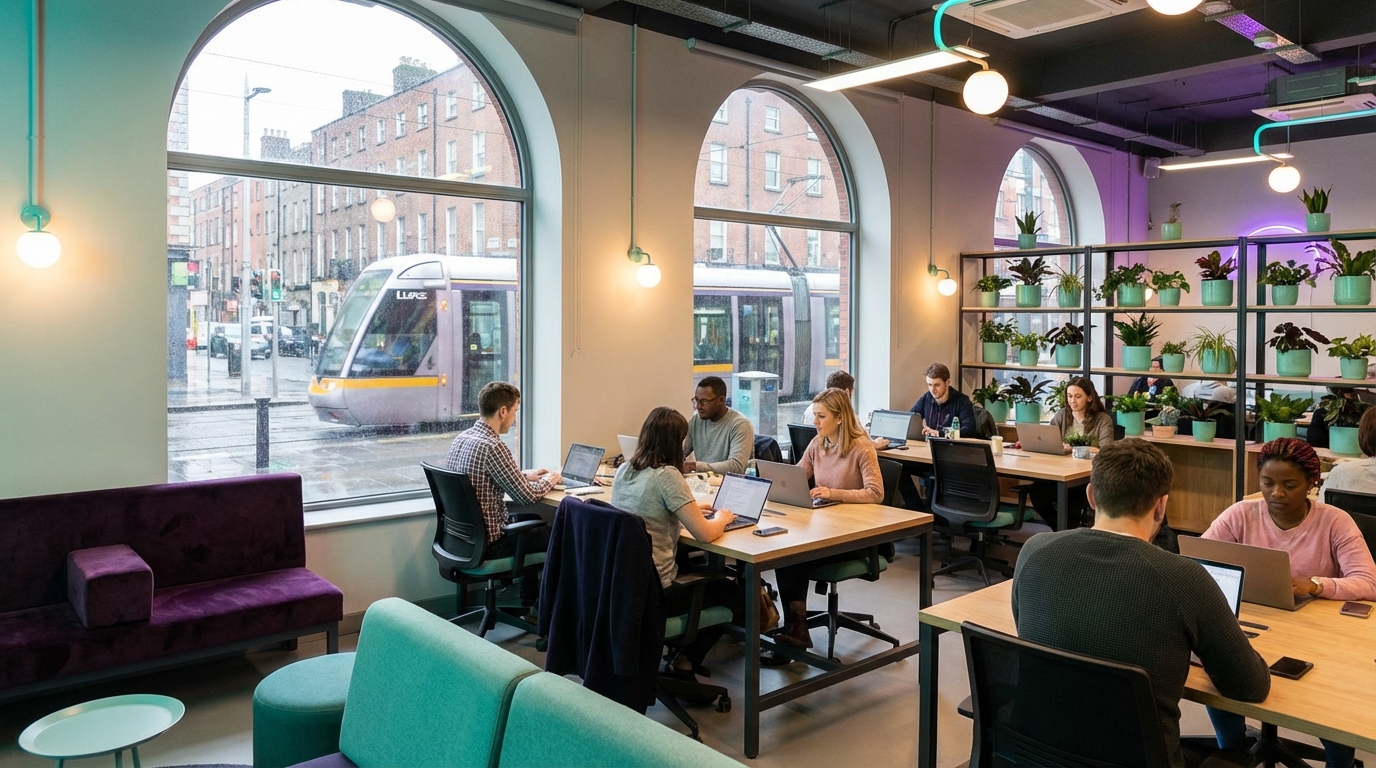
These are the buildings people mention when they say “we are based near the big tech offices”. Think modern fit-outs, plenty of glass, and a tenant mix that includes SaaS, design agencies, and remote teams for global companies.
Common traits:
– Hot desk day passes usually in the €25 to €40 range.
– Monthly hot desk memberships in the €300 to €450 range.
– Multiple meeting rooms, proper podcast/recording space in some cases.
– Regular investor office hours, legal/finance clinics.
From a growth perspective, the advantage is signaling and proximity. When a US investor flies in and wants to meet, saying “we are in [well-known building] right by [big tech HQ]” reduces friction. The building brand can raise your “seriousness” score before you open your laptop.
The downside is cost. If you are pre-revenue, paying €400 per person per month for an unassigned seat can eat into runway quickly. For very early teams, it can make more sense to have one or two hot desk memberships used on rotation, with the rest of the team joining when needed using guest passes.
Mid-market community-focused hubs
Outside the highest-rent zones, you find spaces that lean more into community programs and less into glossy finishes. These play well with Irish startups who want good value but still need structure.
Typical traits:
– Day passes between €18 and €30.
– Monthly hot desks between €220 and €320.
– Strong local network: accountants, lawyers, early-stage funds, accelerators.
– Mix of dedicated desks, hot desks, and small team offices.
Business value: good balance between cost and benefit. If your startup is at pre-seed or seed, spending here usually makes more sense than premium hubs, unless your client base and hiring pipeline depend on postcode perception.
For freelancers, mid-market spaces often provide the best return. You get enough buzz to meet potential clients, but not so many non-stop events that you lose focus.
Budget and niche spaces
A layer below you find smaller or more focused operators: maybe targeting creators, developers, or specific verticals. They sometimes sit above cafes or in repurposed buildings.
Traits:
– Day passes around €10 to €20.
– Monthly hot desks from €150 to €220.
– Fewer meeting rooms, more open seating.
– Stronger personality, sometimes with a specific tech niche (Web3, gaming, etc).
The ROI tradeoff is tricky. If you work in that niche, the density of relevant contacts can be very high. A small Web3-focused space with only 30 people can still be more useful to you than a 500-person generic hub. For broader tech or consulting work, lower cost is the main draw.
“Many early Dublin co-working reviews fixated on coffee machines. The real metric is: did this desk change our revenue chart over 6 to 12 months.”
Hot desk pricing models: how Dublin compares
Here is a simplified look at how a freelancer or founder might compare hot desk options within Dublin.
| Model | Typical Dublin price (monthly) | Ideal user | Business upside | Main risk |
|---|---|---|---|---|
| Premium hub hot desk | €320 to €450 | Funded founders, consultants, remote employees | Brand signal, investor proximity, strong infrastructure | High burn if revenue is not stable |
| Mid-market hot desk | €220 to €320 | Early-stage startups, freelancers | Balance of cost and community, decent meeting rooms | Less “wow” factor for international clients |
| Budget hot desk | €150 to €220 | Bootstrappers, students, side projects | Low overhead, more months of runway | Fewer facilities, weaker network effects |
| Day-pass only use | €10 to €40 per day | Occasional users, visiting founders | Extreme flexibility, no long-term commitment | Higher cost per day if used frequently |
From this, you can estimate your own break-even. For example, if a day pass costs €30 and a monthly hot desk membership at the same space costs €300, then by the 10th day you have reached parity. If you are going to be in a space more than 8 to 10 working days per month, the membership often pays off.
Neighborhoods and ROI: where in Dublin to sit
Location is not just commute and coffee options. It affects your ability to recruit, partner, and meet clients.
Grand Canal Dock / Silicon Docks
This is where many global tech firms have their EU HQs. A hot desk here trades on address value. Startups that sell into tech or digital marketing see more upside here than in a random industrial park.
Business value:
– Higher chance that your next client or partner is in walking distance.
– Good for talent who already commute in from various parts of the city.
Tradeoff: stronger pull on salary expectations. If you hire someone who walks past large logos every morning, their mental pay baseline shifts upwards.
City center (around Dame Street, Abbey Street, etc.)
Central spots appeal to agencies, product studios, legal firms, and early-stage founders who want easy transit access.
Business value:
– Neutral ground for clients.
– Easy access from public transport, which supports hiring from wider areas.
Risk: noise and distraction. Some city center spaces have a more transient feel, with many day-pass visitors and tourists mixing in.
Smithfield, Portobello, and fringe zones
These areas often host mid-market or niche spaces. The commute pattern can be friendlier for people who live north or south of the core.
Business value:
– Slightly lower price per desk.
– Strong sense of local community.
Recruitment angle: a candidate who lives near these areas may prefer them to the docks. For hybrid teams, placing your base where your core employees live can save time and reduce burnout.
What “best” means for hot desks in Dublin
Ranking co-working spaces only by Instagram appeal is a marketing exercise, not an operational one. The “best” hot desk for you hinges on 4 main metrics:
1. Revenue impact
2. Cost control
3. Talent pull
4. Focus and productivity
1. Revenue impact
Track this with simple questions:
– Did you meet clients, investors, or partners through the space?
– Did events or introductions from the community team lead to actual deals?
– Does the space’s brand or address help you win trust faster?
If the answer is consistently yes, paying higher rent can be rational. If not, you might be paying extra for a myth.
2. Cost control
Founders often underestimate the full cost of a “cheap” office, where you add furniture, cleaning, insurance, Wi-Fi, and meeting room fit-outs. Hot desks embed these in a single fee. The key here is predictability.
Ask:
– Is the pricing transparent, or full of add-ons?
– Are meeting room hours included, or are you paying high hourly rates that spike your bill?
– How easy is it to scale up or down month to month?
If a Dublin space lets you move between 2 hot desks and 5 quickly, with simple billing, that flexibility is worth money. Your finance model should treat that like buying an option instead of a fixed obligation.
3. Talent pull
The job market for engineers, designers, and growth marketers remains tight. Remote work gave talent more leverage. Many now expect better work environments.
Being able to say “we work from [credible co-working hub]” can offset the fact that you are still early-stage and cash-conscious. People want to work somewhere that is not an improvised kitchen table.
Questions:
– Would you feature this space in your recruitment materials with pride?
– Do your current team members actually want to commute there?
– Does the building feel safe and accessible at different hours?
If the answer is no, you might face higher churn or find it harder to persuade top candidates.
4. Focus and productivity
Nice furniture and free beer have no direct correlation with deep work. The best Dublin hot desks handle noise and distraction thoughtfully.
Look for:
– Phone booths and separate call areas, so the main floor stays quiet.
– Clear norms around loud calls and meetings.
– Enough meeting rooms that you are not fighting for slots.
If you cannot hear yourself think, productivity drops and the ROI collapses. Before committing, use a day pass and work a full day on real tasks. Do not just tour the building at 11 am when it is quiet.
Retro specs: co-working user feedback from the mid-2000s
To see how far shared workspaces have come, it helps to look back at early online comments about Dublin shared offices and global co-working trends from the mid-2000s. These snippets capture what users valued then versus now.
“Back in 2005 all I needed was a flat surface, Wi-Fi, and maybe a socket that did not fall off the wall. Shared offices were a cheaper alternative to renting a whole space, not a community experiment.”
A lot of early users treated shared spaces simply as flexible offices. Community was an afterthought. There were few dedicated event programs, and hot desking in the modern sense was rare. Many people had fixed desks or small private rooms.
“User review, 2005: The good thing is I can split the rent with others, the bad thing is there is one meeting room and everyone wants it on Tuesdays. Still better than signing a three-year lease.”
Compare that to now, where the conversation around Dublin hot desks includes mental health, networking, founder support groups, and structured matchmaking.
To underline the shift, look at this contrast between a mid-2000s shared office and a modern Dublin tech hub.
| Feature | Shared Office c. 2005 | Modern Dublin Co-working Hub |
|---|---|---|
| Desk style | Mostly fixed desks, rarely hot desks | Mix of hot desks, dedicated desks, team pods |
| Community role | Informal chats, no dedicated community manager | Structured events, intros, Slack groups |
| Tech setup | Basic Wi-Fi, shared printer | High-bandwidth internet, video booths, podcast rooms |
| Target user | Small local businesses, solo professionals | Startups, remote staff for global companies, freelancers |
| Contracts | Paper leases, limited flexibility | Digital sign-up, easy month-to-month changes |
These shifts matter because expectations have changed. A modern Dublin founder comparing hot desks is not comparing “office vs no office”. They are comparing “growth engine vs basic shelter”.
How to run the numbers on a Dublin hot desk
To decide if a space belongs on your shortlist, run a simple three-part check:
1. Direct cost per productive day
Take your monthly hot desk fee and divide it by the realistic number of days you will be in that space, not the theoretical maximum.
Example:
– Fee: €320 per month
– Realistically in the office: 12 days per month
– Cost per day: about €27
Compare that to your day-pass alternative and to your own day rate if you are a freelancer. If you bill €500 per day, paying €27 for a setup that helps you focus and look professional on calls is easy to justify. If you are pre-revenue and live far away, that number might feel heavy.
2. Time saved vs home or cafe setup
Time has a cash value. If a central Dublin space cuts your commute compared to trekking to a suburban office park, or cuts your daily context switching, your effective hourly rate rises.
Ask:
– Do you spend less time troubleshooting Wi-Fi or background noise?
– Do client calls run smoother, leading to fewer reschedules?
– Do you waste fewer hours on “soft tasks” because the environment nudges you to work?
These are softer metrics, but founders who track them often see concrete gains.
3. Relationship yield
Set a 6-month review:
– How many useful warm intros came from this space?
– How many times did you get help that would have cost you money elsewhere (e.g., a tax question from a neighbor, a product critique from another founder)?
– Did any of that convert into revenue or cost saving?
If the sum feels small, look at spaces with a different member mix. Dublin’s scene is still compact enough that word of mouth will quickly point you to buildings where “stuff actually happens”.
Who should pay for the hot desk: founder, client, or employer
In Dublin, you see three payment models:
1. Founders and freelancers pay from their own business account.
2. Employers give remote staff a co-working allowance.
3. Agencies build co-working fees into client retainers as part of delivery cost.
Each model shapes how people behave in the space.
If you pay personally, you tend to push for value: attend events, meet people, squeeze every hour out of the membership. If your employer covers the bill under a generic “remote work budget”, usage can drift. The risk is that hot desks become a perk rather than a driver of results.
To keep discipline, tie the desk to outcomes:
– For sales staff: more in-person team days tied to pipeline reviews.
– For founders: structured weekly “office days” where you handle all partner and investor calls.
– For freelancers: a target number of client calls or proposals sent from the space each week.
When you attach habit to a location, the ROI of that location rises.
What to test on your first visit
Before you sign up, treat the first day as both a workday and a stress test. In Dublin, weather, noise, and connectivity can all surprise you.
Run through this checklist in practice, not on a tour:
– Join a video call during peak hours. Check audio, video, background.
– Try booking a meeting room on the same day and also for a future slot.
– Use the kitchen, bathrooms, and any lockers. See how crowded they get.
– Ask 2 or 3 members how long they have been there and why they stay.
You are not looking for perfect answers. You are looking for honesty. If people grumble about billing confusion or constant noise, treat that as a signal.
Final thoughts on picking a Dublin hot desk
The Dublin co-working story has moved from scrappy rooms with random desks to a portfolio of products that sit somewhere between office, club, and growth engine. When you evaluate hot desks now, the core question is not “is this nice” but “does this space move our business forward faster than the cash it burns”.
Founders who treat their hot desk as part of their go-to-market stack get better returns. They show up, meet people, host office hours, and plug into the operator’s programs with intent. Remote employees who treat it as a structured replacement for HQ also gain, especially if their teams create rituals around office days.
The market in Dublin will keep shifting. New buildings will open, some operators will consolidate, and pricing will move with interest rates and global tech hiring. The principle stays stable: pick the hot desk that sharpens your revenue, protects your runway, and keeps your team wanting to come back in next week.